Discover the best sights in Vienna like Schönbrunn Palace and the Hofburg Palace
Great insider tips for your Vienna trip
Interactive map with all Vienna highlights
Exciting activities in Vienna for the whole family
Recommendable Vienna travel guide
Our top 10 sights in Vienna
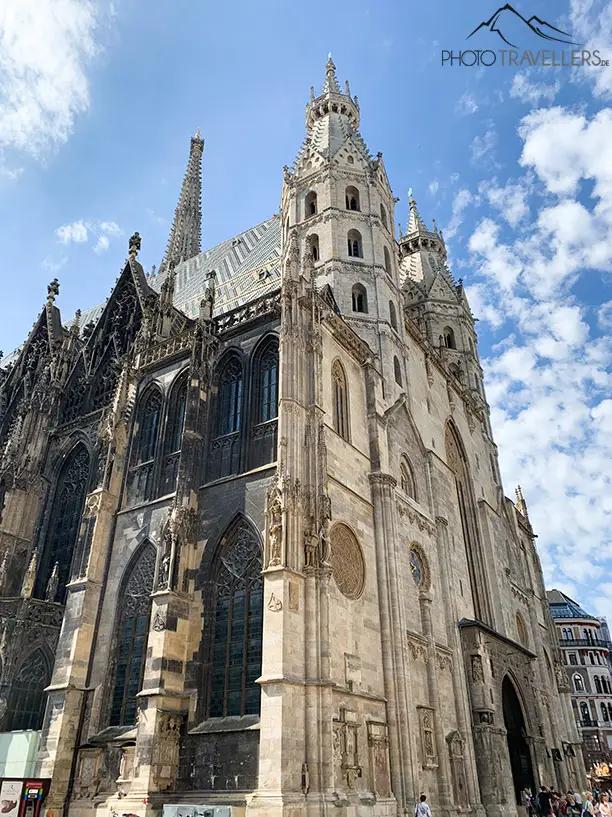
St. Stephen's Cathedral is one of the most famous sights in Vienna. We show you our top highlights here
Here you will find our personal top 10 sights in Vienna at a glance.
Schönbrunn Palace with zoo
Hofburg Palace
State Hall of the Austrian National Library
St. Stephen's Cathedral with the Catacombs
Capuchin Crypt
Prater (Wurstelprater)
Danube Tower in the Danube Park
Vienna City Hall
Belvedere Palace
Naschmarkt
At the end of the article you will find our interactive Vienna map with an overview of all Vienna sights.
Schönbrunn Palace + Zoo: the top attraction in Vienna 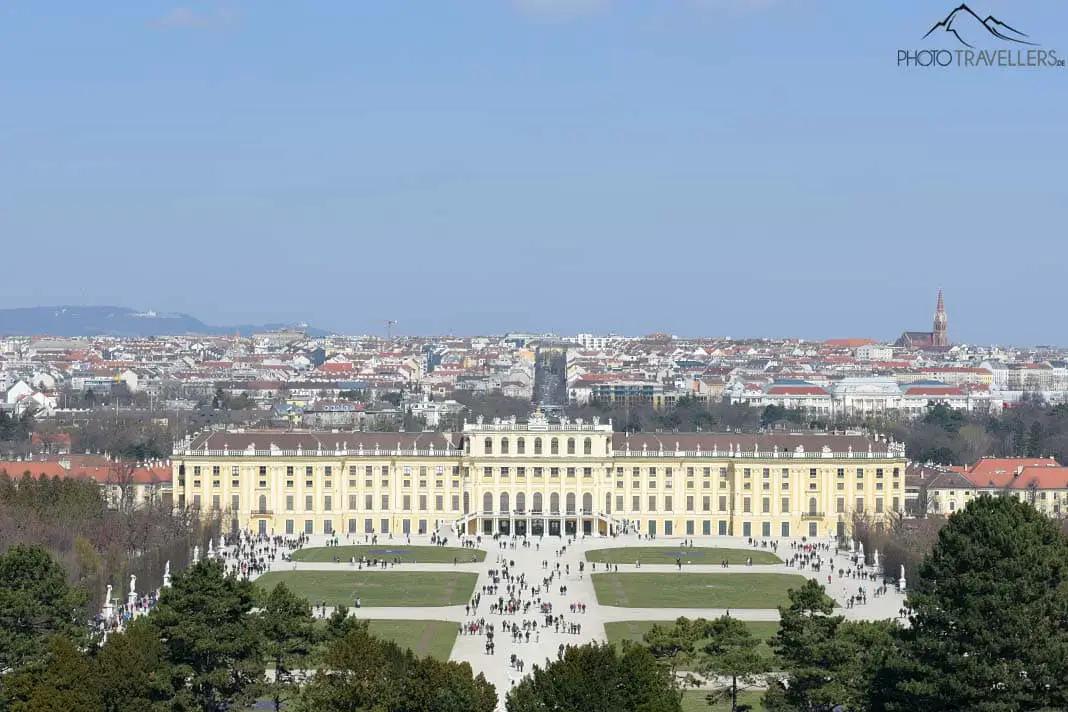 From a hill in the palace park you can enjoy a great view of the famous Schönbrunn Palace, Vienna's most famous tourist attraction.
Schönbrunn Palace is one of the most famous tourist attractions in Vienna. So Schönbrunn Palace is one of the must-see places on a trip to Vienna.
The World Heritage Site is Austria's most visited attraction. The baroque palace and the huge palace garden was owned by the Habsburgs for centuries and was the summer residence of the imperial family.
Emperor Franz Joseph and his Empress Sisi, as she is affectionately known, resided here. By the way, Emperor Franz Joseph reigned from 1848 to 1916. We are absolute Vienna fans and enjoy visiting this beautiful place almost in the middle of Vienna every time.
Schönbrunn Palace invites you on a journey into the past - after all, the entire complex is still largely in its original historical state.
Admission to the palace gardens, where you can easily spend half a day, is free. You need a ticket to visit the palace with its huge ceremonial hall or the bedroom of Emperor Franz Joseph. If you don't want to queue for hours, you should order the tickets for the guided tour in advance on the internet*.
Another highlight is the Schönbrunn Zoo. The oldest zoo in the world is located in the middle of the imperial summer residence. You can buy your ticket online here*.

Tip: To explore Vienna's highlights in comfort, it's worth buying a ticket for a sightseeing tour on the Hop-On/Hop-Off bus*. To explore Vienna and the many sights of the city at a reasonable price, we recommend the Vienna Explorer Pass from Go City(order here*).
Our hotel tips for Vienna
2. the Hofburg - an absolute must-see  The Hofburg is of course one of the top tourist attractions in Vienna
Another highlight in Vienna is the Hofburg, which was the centre of the Habsburg sphere of influence for centuries. Until 1918, the castle complex was even the political centre of the monarchy.
When you stand in front of the imposing building, you will be speechless. The Hofburg is simply magnificent and without a doubt one of the must-see places in Vienna.

You should definitely see the Hofburg from the inside
Today, the Federal President, the Minister of the Chancellery and the Secretaries of State of the Republic reside in the Hofburg. The Hofburg also houses institutions such as the Spanish Riding School and the Austrian National Library.
Sisi fans should visit the Sisi Museum. The guided tour of the Hofburg and the Sisi Museum is very worthwhile(ticket*).
But the Imperial Apartments and the Silver Chamber, a comprehensive collection of imperial utensils, can also be visited and will delight.
By the way, there are many opportunities to discover the famous Spanish Riding School. For example, you can watch the Lipizzaners training*, book a classical guided tour of the Spanish Riding School* or attend a performance by the Lipizzaners*.

In the Vienna Hofburg you can admire knight's armour, among other things. 3. 3. the State Hall of the Austrian National Library  The State Hall of the National Library consists of two side aisles and a huge dome. In the centre is a huge statue of Emperor Karl
Ancient books displayed in magnificent rooms - what could be better? We are absolute library fans.
That's why we were so thrilled by our visit to the State Hall of the Austrian National Library. No wonder, the State Hall is one of the most beautiful historical libraries in the world.
Incidentally, Emperor Charles VI (1685 to 1740) ordered the construction of the Baroque-style Court Library. The plans for the court library were drawn up by the famous court architect Johann Bernhard Fischer von Erlach.
The ceiling frescoes were painted by court painter Daniel Gran. The National Library is one of the most beautiful places in the city, and not just for us.
The imposing State Hall of the Austrian National Library is 78 metres long, 14 metres wide and 20 metres high. You could easily fit a whole house in here. Crazy, isn't it?
In the middle of the State Hall is a majestic dome, flanked by two side aisles. The dome is even 30 metres high. In the State Hall you will find 200,000 books dating from 1501 to 1850.

The huge globes in the library are topographically very accurate. There you will find numerous entries on voyages of discovery.  This world map by Martin Waldseem is unique. The original is in Washington D.C. ⭐ Recommended Vienna travel guide
We highly recommend this travel guide for your trip to Vienna:
 "/>
"/>A unique experience is a helicopter flight over Vienna, which you can book here*.
4 The imposing St. Stephen's Cathedral with the catacombs
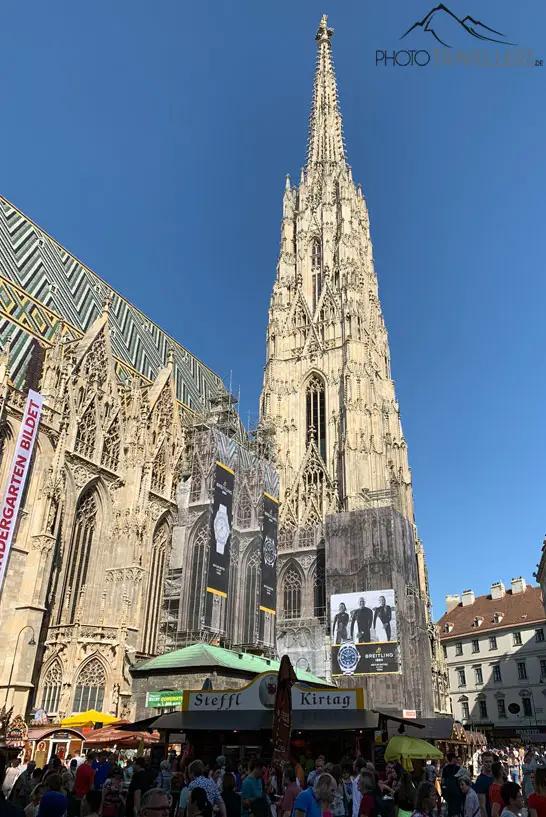
St. Stephen's Cathedral is the city's landmark
St. Stephen's Cathedral(actually the Cathedral Church of St. Stephen in Vienna) in the heart of the city is the landmark of the Danube metropolis. The south tower, as the main spire, rises 136 metres into the sky.
We love strolling through the streets of Vienna. And when the colourful bricks of the cathedral appear in our field of vision, we are enchanted every time. Vienna is such a beautiful city.
If you're already amazed by this imposing building from the outside, you won't be able to stop marvelling inside.
The history of the cathedral is super interesting. The first church was built here in 1137. Admission is free.
The guided tour of the catacombs is highly recommended (6 euros, as of November 2022). Under the cathedral are about 30 burial chambers in which numerous Habsburgs (including Napoleon Franz Bonaparte) as well as Vienna's cardinals and archbishops and members of the cathedral chapter are buried.
Under St. Stephen's Square are more crypts - here more than 10,000 dead were buried in plague pits. An eerily creepy experience for young and old.

St. Stephen's Cathedral is a top attraction and should be on every Vienna programme.
Near St. Stephen's Cathedral is the Plague Column. It is also worth a visit.
Tip for music fans: A highlight in St. Stephen's Cathedral are the classical concerts. You can buy tickets for this great event here*.
5 The creepy Capuchin crypt  The Maria Theresa Crypt is particularly impressive.
Did you know that you can visit the tomb of the famous Empress Sisi in Vienna? She is buried in the Capuchin C rypt. Many other royal coffins can also be found there.

A large skull emblazoned on the imposing coffin
For four centuries, the mendicant order of the Capuchins has watched over the graves of the Habsburgs. 150 people lie in the Capuchin crypt today.
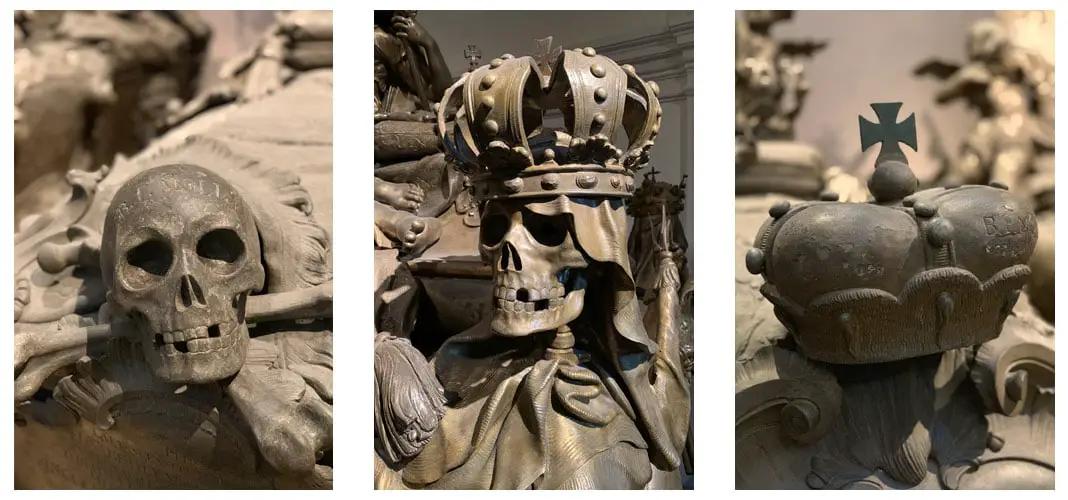
It's a little creepy in the crypt, after all 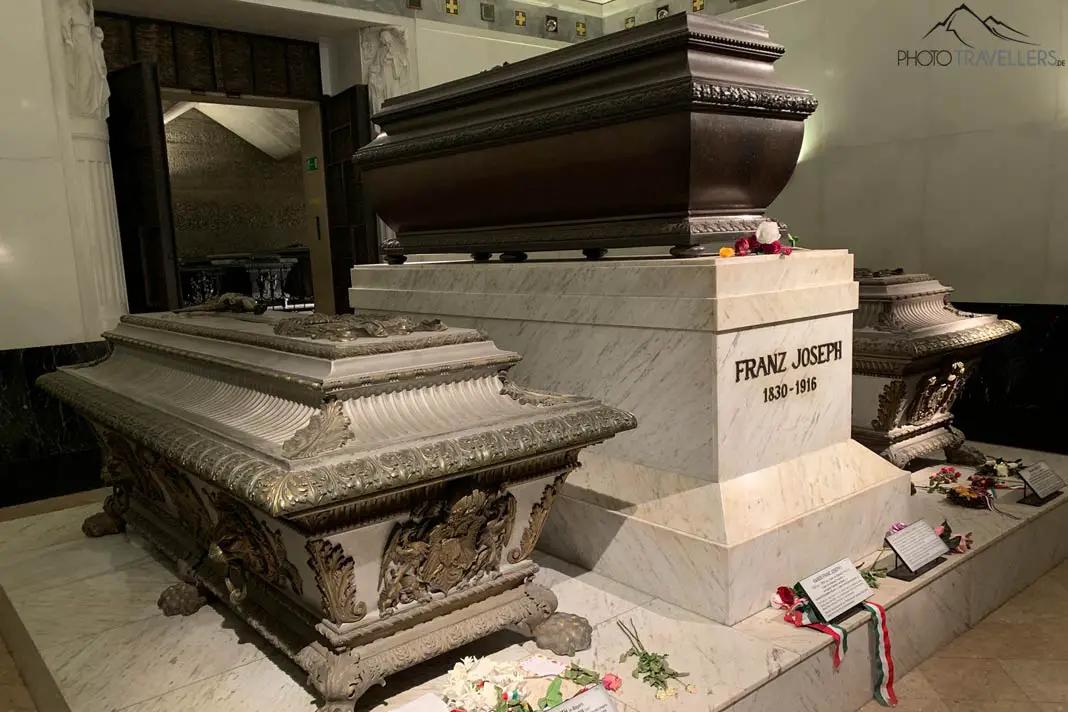 On the front left you can see Sissi's coffin. In the middle is the coffin of Franz Joseph.
Empress Maria Theresa also lies down there in a magnificent coffin. She had her tomb built during her lifetime. The popular emperor Joseph II wanted a simple coffin. You can also see this in the crypt.
Information panels tell stories about the buried Habsburgs.
6 The Prater (Wurstelprater)  The famous Viennese Ferris wheel in the Prater
It smells of candy floss, roasted almonds and music sounds from the loudspeakers. Now it's clear where we are, isn't it? Exactly, at the Vienna Prater. We are talking about the Wurstelprater amusement park. On a six-square-kilometre meadow landscape, countless rides stand year in, year out.
One of the top attractions is the Wurstelprater with the Vienna Giant Ferris Wheel as its landmark. The Giant Ferris Wheel was built in 1897 to celebrate the 50th anniversary of the throne of Emperor Franz Joseph I. At the time, it was 65 metres high and one of the largest Ferris wheels in the world.
The Prater attracts around three million visitors a year and has much more to offer than just the historic Ferris wheel. Roller coasters, ghost trains, bumper cars and countless other rides and stands make the Prater a pleasure for the whole family. Honestly, you shouldn't miss it.
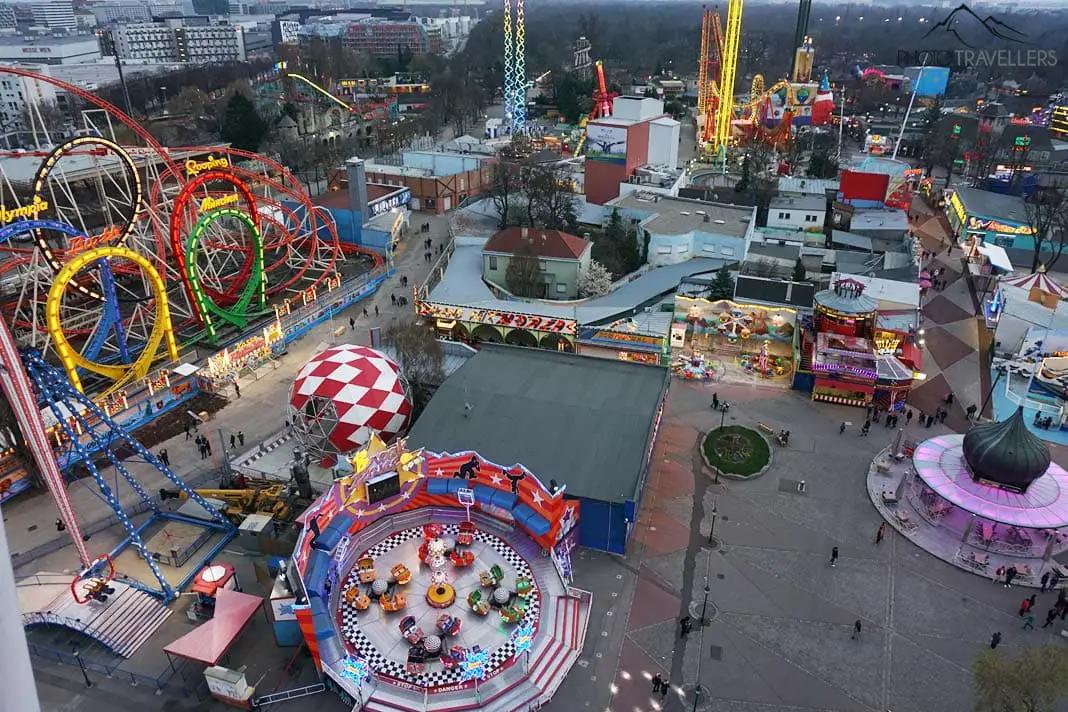
The Prater, seen from the Ferris wheel
With the Vienna Pass* you can ride the Ferris wheel for free. Another tip: Book a ride on the Ferris wheel without queuing here*.
7 The Danube Tower in the Danube Park 
One of the city's most famous landmarks is the huge Danube Tower in the beautiful Danube Park, a popular destination not only at weekends.
The 252-metre-high observation tower is Austria's tallest structure even before St. Stephen 's Cathedral, making it a sight visible from afar in the Danube metropolis.
The tower head houses the tower café at a height of 160 metres and the tower restaurant at a height of 170 metres. The view of Vienna from the Danube Tower is - how could it be otherwise - phenomenal.
Depending on the wind and weather, you can look down on Vienna and the surrounding landscape from the open terrace or from the glazed panorama terrace. To avoid long waiting times, you should buy your ticket for the Danube Tower in advance online*.
8 The imposing Vienna City Hall 
With a height of 103 metres and a neo-Gothic façade, Vienna City Hall is definitely one of the most impressive city halls in the world. Around the town hall square, under the trees, countless visitors flock in summer to enjoy the unique atmosphere.
The whole area is very beautiful. Long benches invite visitors to linger. The park is populated by the Viennese in summer. There is something going on everywhere. No wonder with this beautiful place.
A visit to the City Hall is an absolute must on every trip to Vienna. Thanks to its central location, the City Hall is easy to reach by bus and train. A guided tour of the town hall is also recommended.
9. the beautiful Belvedere Palace  The upper part of the Belvedere Palace with the spacious water complex
Belvedere Palace is a wonderful baroque ensemble. The rooms of the palace can be visited, and changing exhibitions are also held in the Belvedere Palace.
The beautifully landscaped palace park is freely accessible and invites visitors to linger with its spacious lawns, impressive fountains and numerous park benches.
There is the Upper Belvedere and the Lower Belvedere. You should definitely let yourself drift here and enjoy this beautiful place in Vienna.
You should book your tickets to visit the beautiful Belverdere Palace online in advance*.
10. the famous Viennese Naschmarkt  The Naschmarkt is a must on our list of Vienna's most beautiful sights. The stalls tempt you with all kinds of delicacies, such as the dried fruits shown here.
You'll get wide-eyed here at the latest. The Naschmarkt is the most famous market in Vienna. Around 120 stalls and restaurants spoil visitors with a colourful culinary offer of fruit, vegetables, cheese, fish, sausages and other delicacies from all regions of the world.
As we strolled through the Naschmarkt, we couldn't help but try one or two delicacies. That's exactly what makes the Naschmarkt so special.
No one will go home empty-handed here. However, the price level is high, after all, the Naschmarkt is a well-known tourist attraction.
The Naschmarkt is not suitable for larger purchases. Unfortunately, many traders often offer the same goods. Although the Naschmarkt has lost its glamour in recent years, a visit should still be on the agenda of every trip to Vienna.
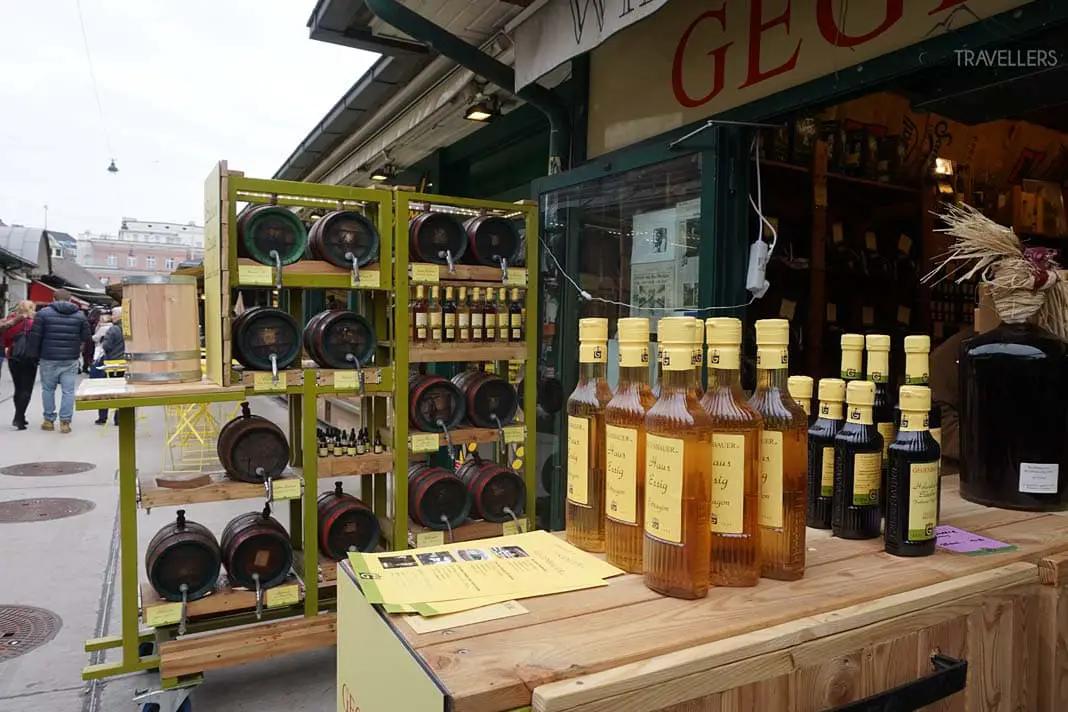
Even if the name does not suggest it: The Naschmarkt also sells solid food such as vinegar. 11 The Karlskirche 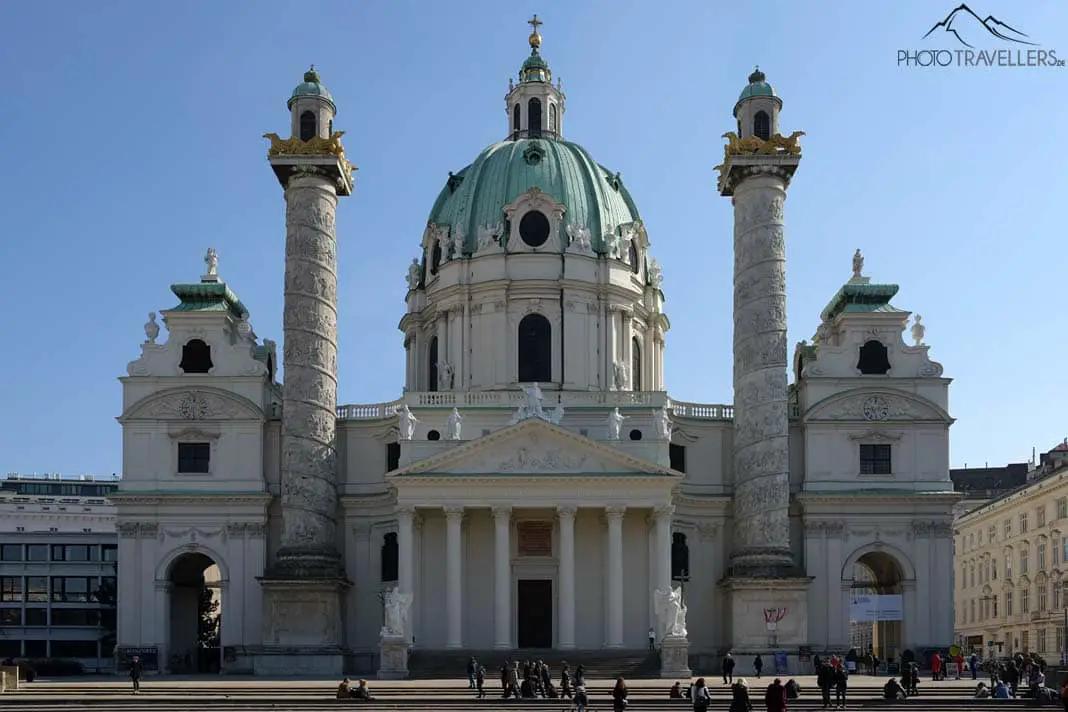 The Karlskirche is definitely worth a visit
The Karlskirche - one of the city's landmarks - immediately catches the eye because of its unusual architecture. The interior of the Karlskirche continues in splendour.

The magnificent Karlskirche from the inside
A panoramic lift takes visitors up to a platform at a height of 33 metres. From the platform you can view the frescoes and see the imposing church interior from a unique perspective.
You can also enjoy a wonderful classical concert in the Karlskirche. Listen to Vivaldi'sFour Seasonsand go on a journey back in time to the musical past. Book your ticket for this unique experience here*.
12 The Hundertwasser House

The Hundertwasser House is one of the city's most famous sights.
The Hundertwasserhaus is one of the most beautiful and best-known sights in Vienna. The colourful building is a real magnet for visitors. Even in the immediate vicinity, small shops sell souvenirs and all kinds of trinkets.
When you stand in front of the Hundertwasser House, you have to put your head back to make sure you can see everything. The house has some interesting corners and beautiful places.
The Hundertwasserhaus was once designed by the architect Josef Krawina and created by the painter Friedensreich Hundertwasser. With its colourful façade, it catches the eye.
However, the façade has not been as colourful as it appears on many posters and postcards for a long time. In front of the building there are numerous tourists who probably get on the residents' nerves.
Access to the building is therefore understandably prohibited. Unfortunately, you don't have a particularly good view of the Hundertwasser House from the street - but you should still have seen it once.
A small shop on the ground floor with souvenirs also invites you to shop.
Tip: Opposite the Hundertwasser House is the Hundertwasser Village - a small shopping mall with souvenirs. This is also designed in the Hundertwasser style and is well worth seeing.

The façade of the famous Hundertwasser House is unfortunately getting on in years.
A highlight that you should definitely see is the toilet in the basement of the Hundertwasser Village. It costs 80 cents to enter and is designed in the colourful style of the Austrian artist. There is also a very funny shit monologue running in the toilet. So it's worth paying a visit to the toilet.
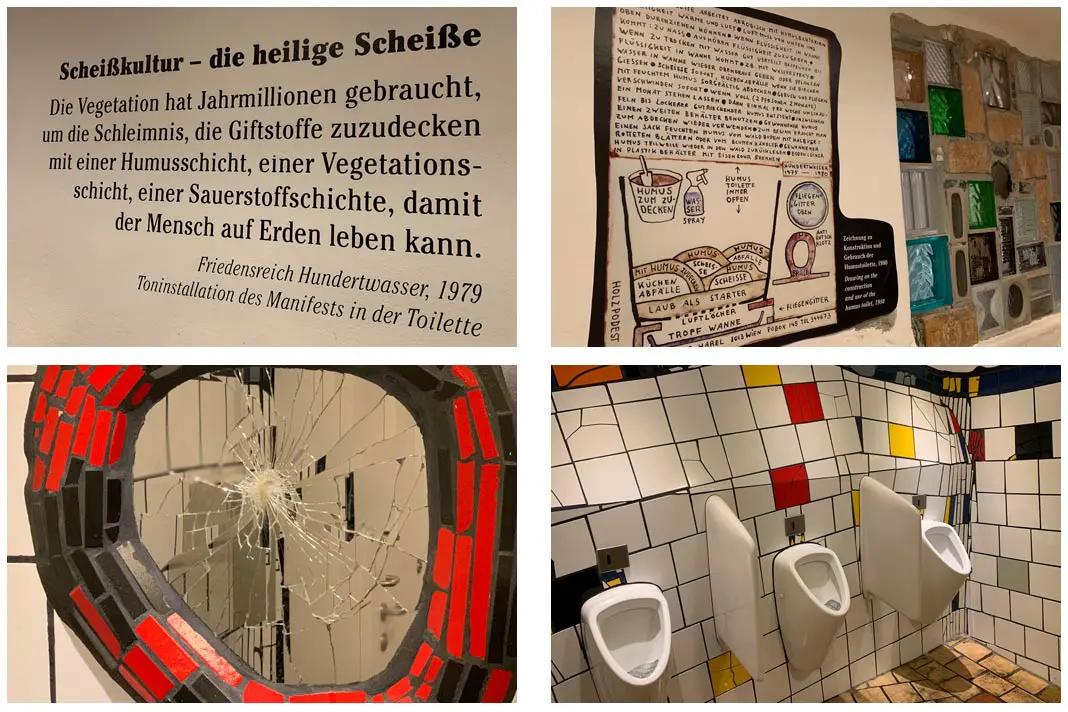
The toilet in Hundertwasser Village is worth a visit 13 Kärtner Straße with the Hotel Sacher & Sacher-Torte 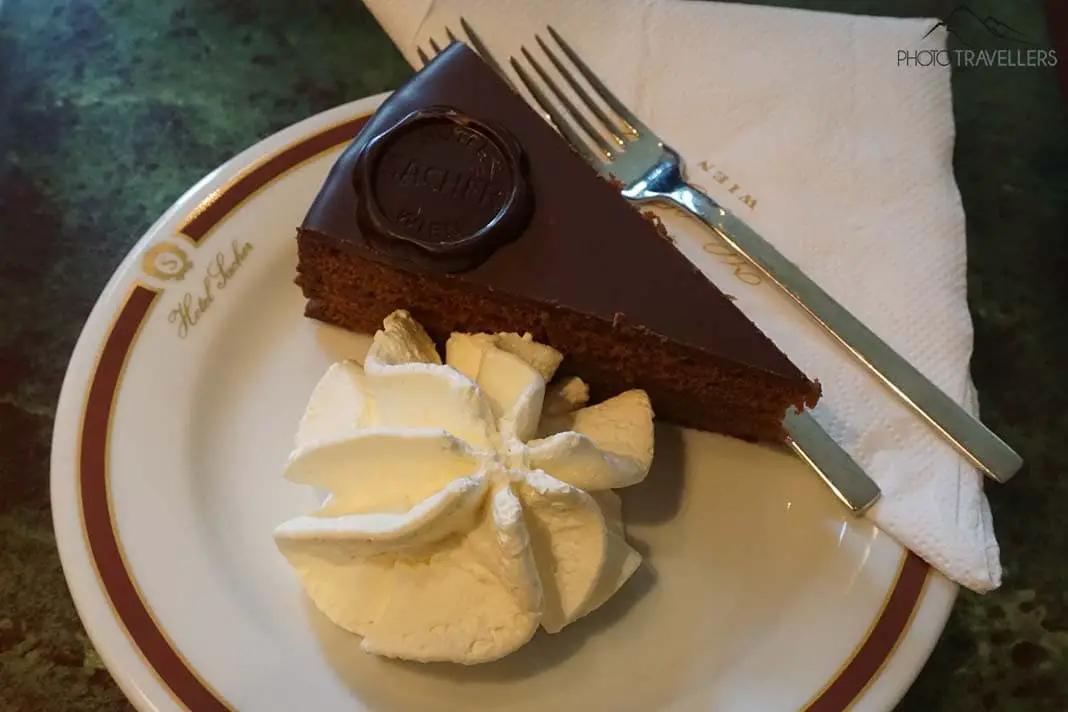 The Sacher Torte at Café Sacher is a treat and a must in Vienna
Part of every visit to Vienna is to try a Sacher Tor te at least once. Where better to do this than at the Hotel Sacher in the Sacher Café on the famous Kärtner Straße? The Sacher Torte has existed in its present form since 1832 and is probably the most famous cake in the world.
Chocolate cake, apricot jam and a fine chocolate coating make the cake what it is. A treat for the palate that is unfortunately not cheap. But hey, how often are you in Vienna?
Tip: At the end of Kärntner Straße, right next to St. Stephen's Cathedral, you'll find "Der Stock im Eisen" on the corner. What you see there behind a glass display case is a Zwieselfichte spruce from the Middle Ages.
Numerous nails were hammered into it. That's why this species is also called a nail tree. The Viennese stick-in-iron is the oldest surviving nail tree. It was first mentioned in a document in 1533.

This tree trunk is studded with numerous nails and is very old.
Kärnterstraße is also home to some really great, quaint shops. So it's worth a wander and a stroll. The pastry shop Sluka, for example, has been around since 1891.
Café Aida has been at St. Stephen's Cathedral since 1913. But the Lobmayr shop, which has been around since 1823, is also worth a detour. You will also pass the Maltese Church. It has been here since 1806.
14 The Parliament 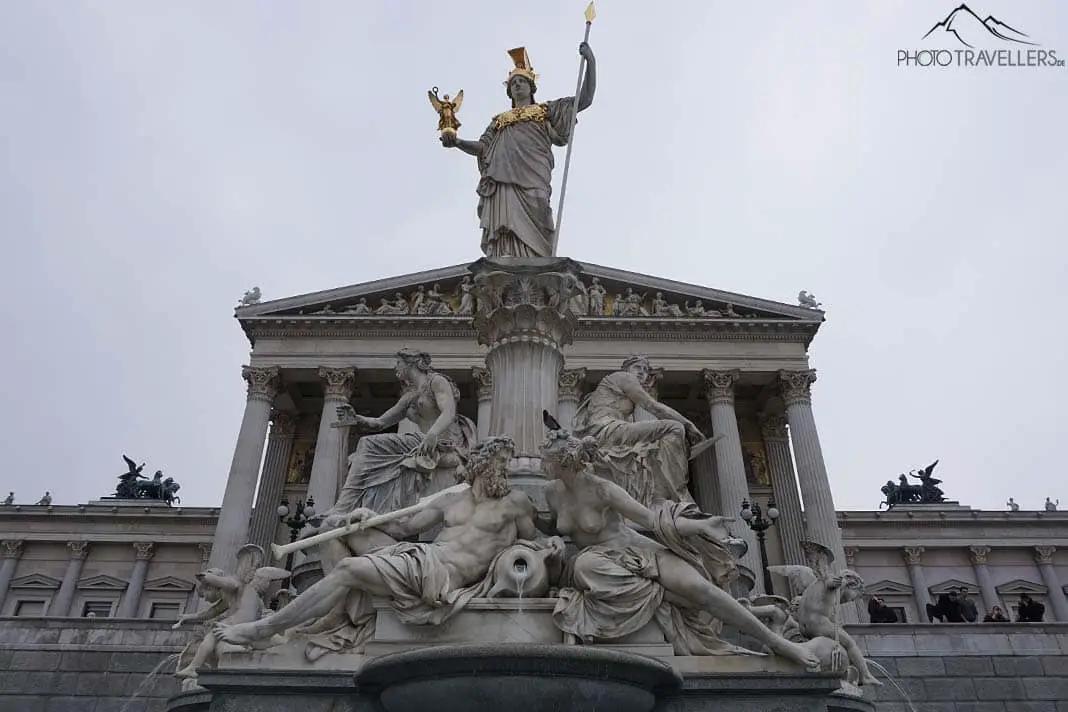 The Parliament building in Vienna with the Pallas Athena Fountain.
The two chambers of the Austrian Parliament meet in the Parliament Building on Vienna's Ringstrasse. Built between 1874 and 1883 in neoclassical style, the building is a popular destination for many tourists.
A highlight is the Pallas Athena Fountain in front of the parliament building. There are also eight statues carved out of marble to admire. Visitors can also take a guided tour of the building or attend a session.
The huge square is beautifully designed and definitely worth seeing. You can tell that we are in love with every sight in Vienna.
15. the votive church  The Votivkirche is a great photo motif in the light of the evening sun
Of course, the Votivkirche is also one of Vienna's most beautiful sights - and incidentally, the church is one of the most important neo-Gothic sacred buildings in the world.
At 99 metres, the Votivkirche is the second highest church in Vienna. The impressive church towers stand out even from a distance. The interior of the church with the high altar and the numerous chapels is absolutely worth seeing.
However, you have to walk a little to get to the Votivkirche. But in our opinion, the walk is worth it. What do you think? Fortunately, Vienna has a well-developed public transport network. The metro stop is called Schottentor.
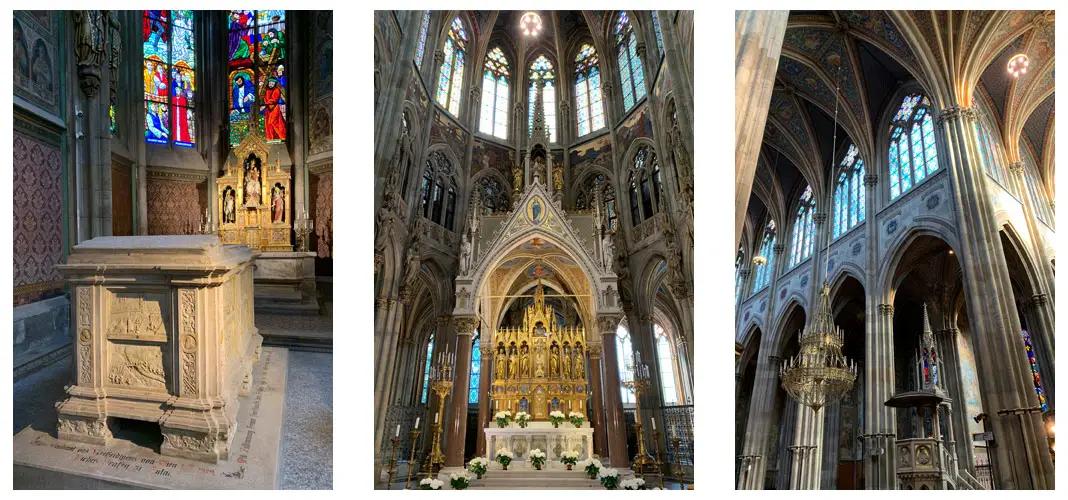
The interior of the Votivkirche is also impressive. 16. 16. the Volksgarten, so popular with the Viennese  The Volksgarten is a feast for the eyes in spring. In the background you can see the beautiful Theseus Temple.
I love it when the roses bloom in summer and it smells so wonderful. If you want to see a true splendour of colourful flowers, then you absolutely have to go to the Volksgarten. It is a small oasis of peace and a wonderful place in the middle of Vienna.
The generously designed park with the white Theseus Temple in the beautifully landscaped park and the rose garden is one of Vienna's green lungs. In summer, it is a great place to sit on one of the many shady park benches.
Since 2001, the Volksgarten with its historic centre has been a UNESCO World Heritage Site. When the roses are in bloom in June, the Volksgarten is always well attended.

Our tip: Go there in the morning. When the morning dew is on the roses and everything is quiet and still, you can take wonderful pictures here.
17 The Natural History Museum  The Kunsthistorisches Museum is a mirror image of the Naturhistorisches Museum.
The Natural History Museum is one of the most important nature museums in the world and one of the largest museums in Austria. A visit to the Natural History Museum is particularly recommended in bad weather.

The pompous exterior of the Natural History Museum continues inside 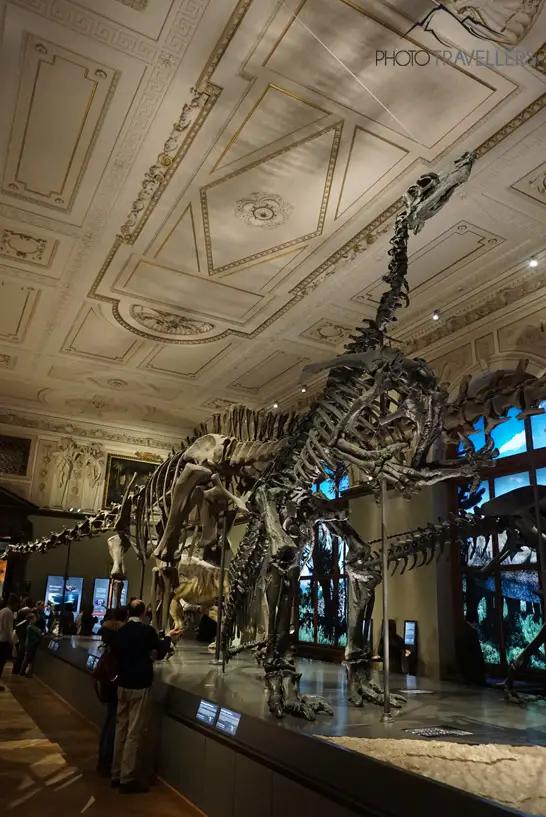
Of course, there are also dinosaur skeletons to admire in the museum
Even the façade of the museum is impressive. In the exhibition rooms you can see dinosaur skeletons, minerals and prehistoric artefacts.
On a gloomy rainy day, the museum is definitely the perfect place for an interesting and entertaining afternoon with the whole family in Vienna.
18. the Museum Quarter Vienna  In the Museumsquartier you will find numerous museums and exhibitions. In the evening, the inner courtyard turns into a large chill-out zone. There are several bars and cafés
Art-loving visitors will find what they are looking for in the Museumsquartier Wien. The huge area includes the Kunsthalle Wien for international contemporary art, the mumok for modern art and the Leopold Museum with works of Viennese Modernism and Austrian Expressionism.
The inner courtyard is always crowded in the summer evenings. We love the flair of the Museumsquartier. In the evening, the courtyard turns into a big chill-out zone. There are several bars and cafés. The Museumsquartier is definitely one of the best places in Vienna to spend a great evening in the summer.
19 The Kunst Haus Wien  The Kunst Haus Wien hosts a Hundertwasser exhibition.
The Kunst Haus Wien is located in the immediate vicinity of the Hundertwasserhaus, but is not as well known. The Kunst Haus Wien houses a museum with works by Friedensreich Hundertwasser.
In addition, temporary exhibitions with works by other artists are shown regularly. The eye-catching Hundertwasser façade in particular attracts some tourists.
If you visit the Hundertwasserhaus, a detour to the Kunst Haus Wien is definitely recommended.
20 The Central Cemetery with Falco's grave  The Dr. Karl Lueger Memorial Church in the heart of the cemetery is an imposing building
First of all: Vienna's Central Cemetery is huge. Personalities such as the music icon Falco lie there, but also other well-known personalities such as Ludwig van Beethoven, Brahms, Johann Strauss and other honorary citizens of the city.
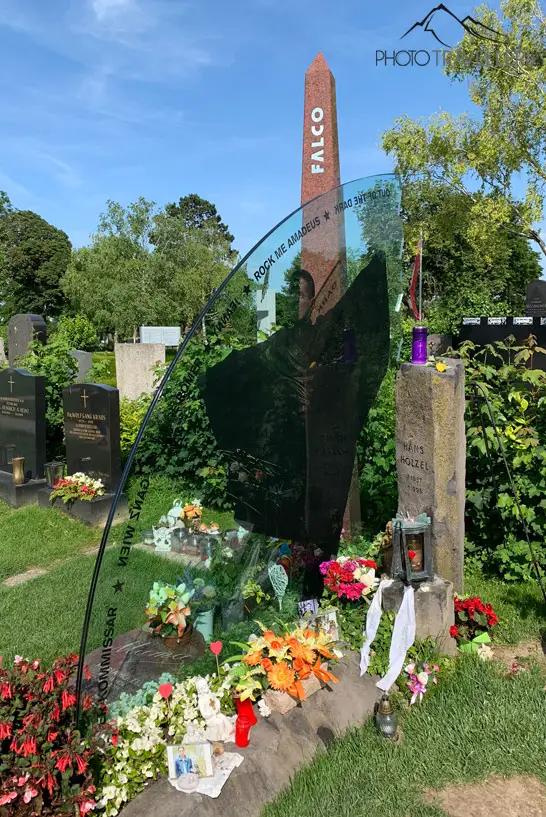
Falco's grave still attracts many fans today
It is best to take the public transport to Gate 3 and then walk to the area of the graves of honour. There you will quickly notice Falco 's distinctive grave. A huge glass sculpture with a print of his photo adorns the grave of the famous musician.

The graves of Johann Strauss, Ludwig van Beethoven and the grave monument of Wolfgang Amadeus Mozart (he lies in another cemetery in Vienna (see the section Mozart Monument in the Burggarten, our sight number 21).
From the graves of honour, you now walk parallel to the entrance and arrive at the imposing Dr Karl Lueger Memorial Church. It is worth taking a look inside. The round room is spanned by a huge dome. The interior is blue - like the sky.
From the church, head towards the exit. On the right, you will pass the graves of famous composers such as Ludwig van Beethoven, Brahms, Johann Strauss and Franz Schubert. Shortly before the exit to Gate 2, it is worthwhile to turn right towards the Gate 3 exit. On the way, you will pass many specially designed graves.
If a cemetery can be a sight to see, then it is definitely the Vienna Central Cemetery.
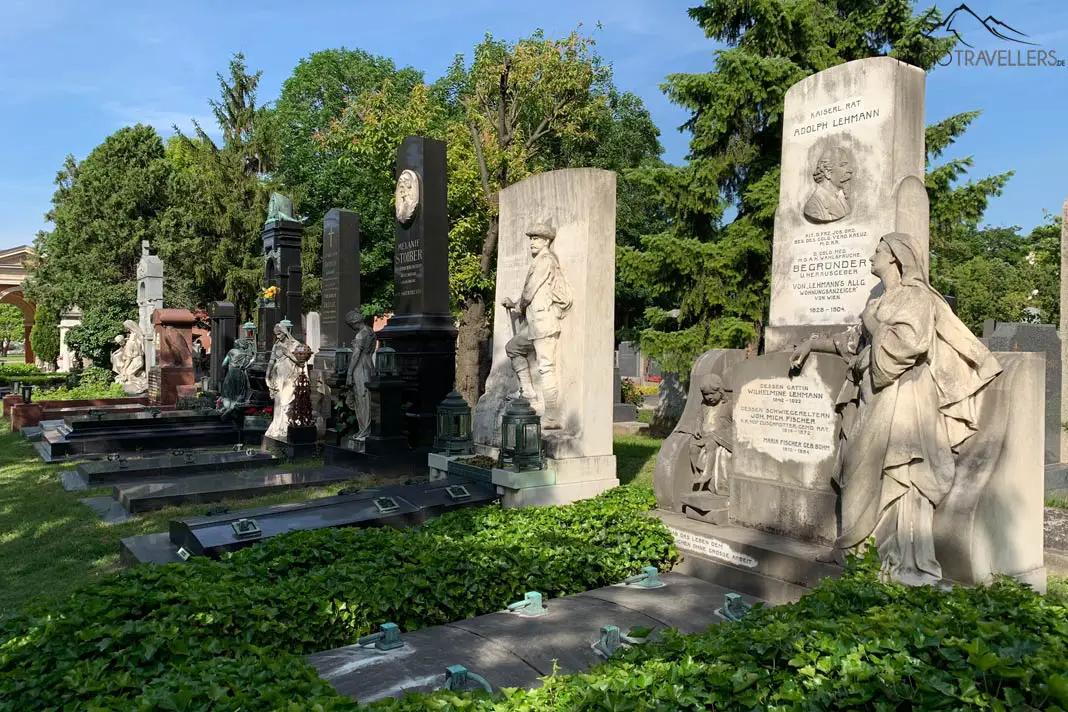
You will always see impressive tombs in the Central Cemetery. 21 The Albertina Art Museum 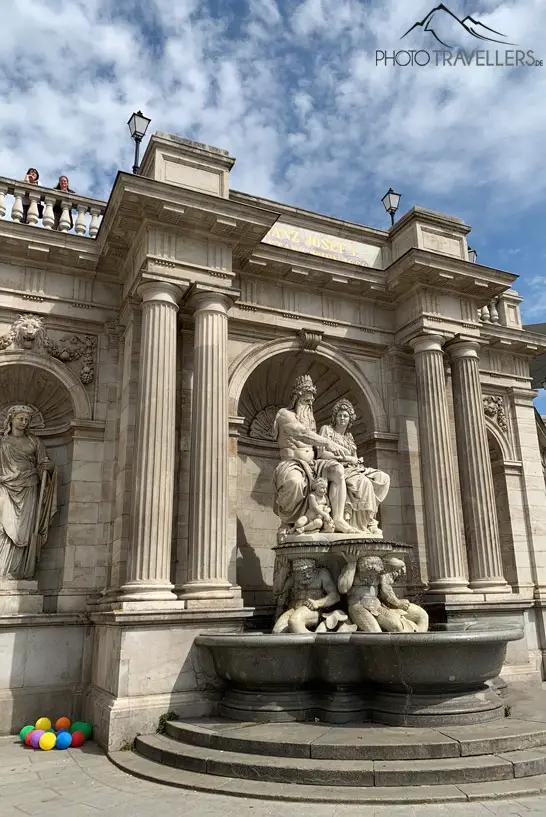
The fountain in front of the Albertina is a nice photo motif
The Albertina is a famous art museum in Vienna. In the Albertina, in the Palais Erzherzog Albrecht, you will find one of the most important graphic collections in the world.
The huge collection comprises around one million drawings and prints. The works of art range from the Renaissance to the present.
Today, the Albertina also shows the private Batliner collection. There is a show on classical modernism entitled "Monet to Picasso. The Batliner Collection".
If drawings don't interest you, a visit to the Albertina is still worthwhile. You can take a look at the rooms of the Habsburgs. The Rococo Room, the Wedgwood Cabinet, the Fireplace Room and the Reception Hall are all worth a visit.
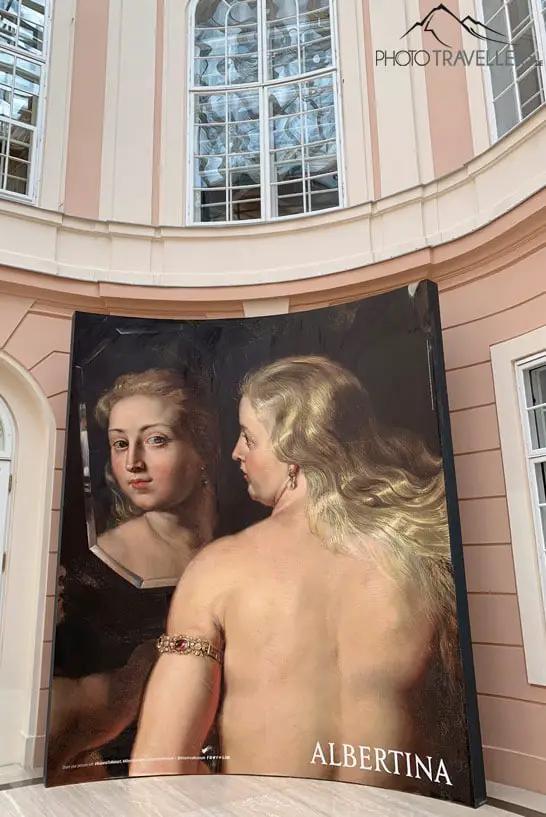
World-class art awaits you in the Albertina. 22 The Mozart Monument in the Burggarten with Butterfly House
From the terrace of the Albertina you have a wonderful view of the Burggarten. In the Burggarten you will find the Mozart Mon ument with the Mozart statue. In summer, the Burggarten is also a nice place to chill out.
Mozart lived in Vienna as a freelance composer for ten years from 1781. Works such as The Magic Flute were written during this time. In the last year, Mozart lived in the Kleines Kayserhaus. It was located at the back of today's Kaufhaus Steffl at Kärntner Straße 19. Today there is a memorial plaque there. Mozart died on 5 December 1791 and was buried in a common grave at the Sankt Marx cemetery. There is only a memorial at the central cemetery.
A visit to the Butterfly House is also worthwhile. Admission costs 7 euros.
23 The Vienna Anchor Clock
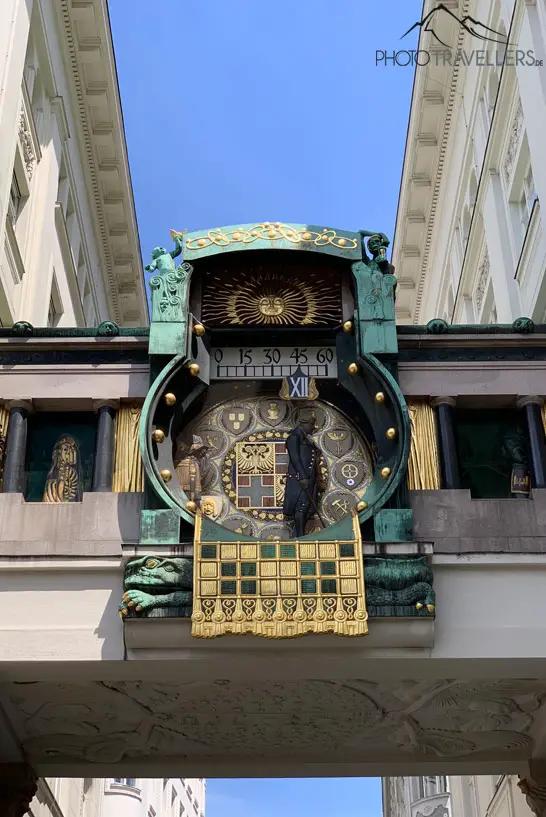
The Wiener Ankeruhr was commissioned by the insurance company Der Anker and created by artists. Here you can see one of the 12 figures
The Ankeruhr is located on one of the oldest squares in Vienna. In former times the command building (Praetorium) of the Roman camp Vindobona was located here. The Anker Clock dates back to the General Insurance Company "Der Anker", founded in 1858.
The insurance company had the Ankerhof built from 1912-1914 and artists erected the Anker Clock. According to the inscription, it is dedicated to the people of Vienna.
Every day at twelve o'clock the twelve figures of the clock move around once. The spectacle lasts exactly twelve minutes and is a great highlight on any trip to Vienna.
The anchor clock reminded us of the famous Glockenspiel on Marienplatz in Munich. The figures depict Emperor Charlemagne, Empress Maria Theresa and many other famous nobles."/>
24. the Ruprechtskirche is the oldest church in Vienna 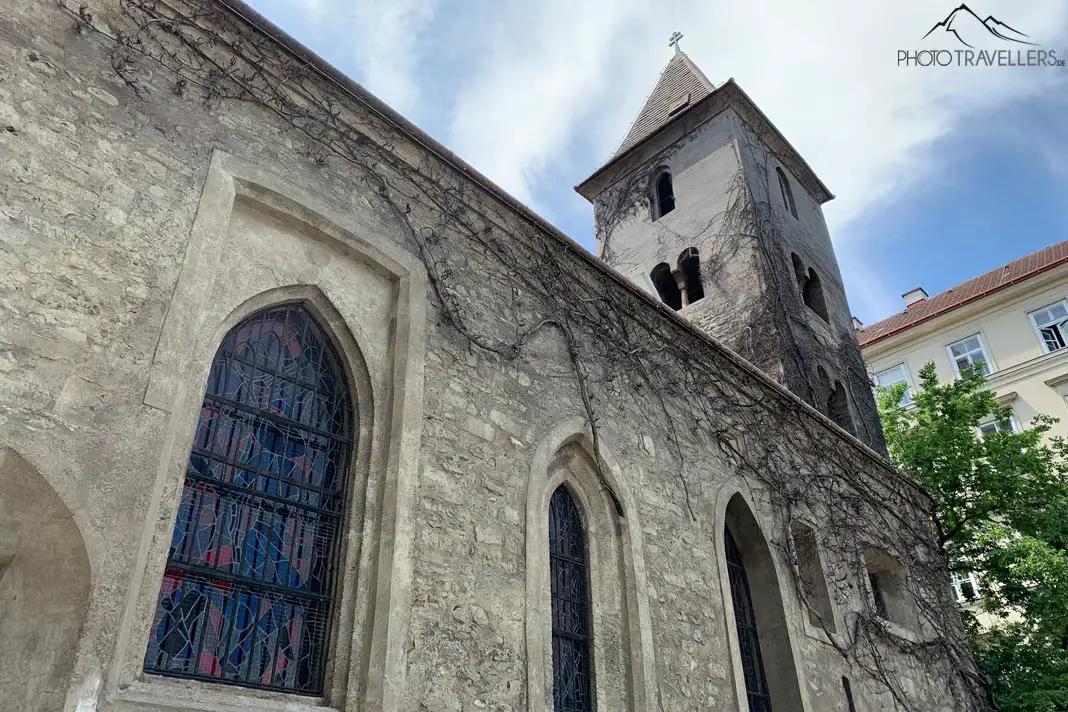 The Ruprechtskirche is the oldest church in the city and a rather lesser-known sight.
The oldest church in Vienna is the Ruprechtskirche on Ruprechtsplatz. The nave as well as the lower tower floors date back to the 11th century. Wicked, isn't it?
Its patron saint is Saint Ruprecht, the patron saint of salt boatmen. The beautiful church was first mentioned in a document in 1200, but according to stories, the church was founded as early as 740.
The church is located near Jewish Lane. It was from here that Adalbert Stifter observed the only total solar eclipse to occur in modern Vienna on 8 July 1842. A sign on the wall of the house commemorates this spectacular observation.
There is plenty to do here in the evening. The bars around the church attract many visitors. For crime scene fans, there is a crime scene evening on Sunday in the Bar Philosoph.
25 The Danube Island  The Danube Island is a popular excursion destination for the Viennese in summer.
Grab a rental bike or an e-scooter and jet off to the Danube Island, Vienna's green lung. When the hustle and bustle of the city becomes too much for the Viennese, they escape to the Danube Island.
The area was built between 1972 and 1988 and separates the Danube from the New Danube. The Danube Island is part of Vienna's flood protection system and is also a popular recreation area.
If you want to relax and enjoy the sun or fire up the barbecue, the Danube Island is the place to be. A highlight for children is the world's largest floating trampoline.
Our Vienna secret tips
Secret tip 1: Creepy cellar tour through the Viennese underworld
Vienna is sifted through like a Swiss cheese. If you want to dive into Vienna's underworld, turn to Peter, who will take you into the darkness. There are old cellar vaults to see, about which Peter has plenty of entertaining and creepy stories to tell. If you're looking for a sightseeing programme with a difference, this is the place for you.
More information about the cellar tour with Peter through Vienna
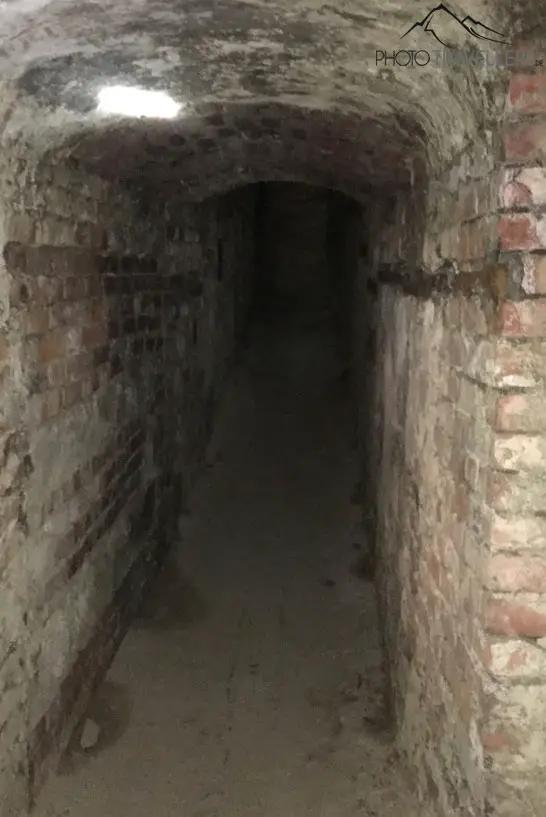
Another real insider tip: the cellar tour through Vienna's underworld
Insider tip 2: Eerie city tour through Vienna's underworld
Another eerie highlight is the city tour through Vienna's underworld. On the tour you will discover the archaeological excavations on Michaelerplatz and the crypt of St. Michael's Church.
Immerse yourself in the city's past and history and see the baroque crypt of St. Michael with the mummies of wealthy Viennese citizens. Goosebumps are guaranteed here. Book your ticket here*.
Insider tip 3: Kreuzenstein Castle
Kreuzenstein Castle is located a few kilometres north of Vienna. Not much remains of the medieval fortifications today. The former knight's castle was replaced by an imposing show castle built between 1874 and 1906. So more appearance than reality? Anyone who doesn't know that Kreuzenstein Castle is not a real knight's castle will never guess.
The complex, in which at least a few remnants of the original castle have been built, is beautifully designed and a worthwhile sight in the Vienna countryside. Apparently many filmmakers also like the castle - Kreuzenstein Castle has been the backdrop for numerous film productions. The beer garden with a magnificent view at the entrance to the castle is also worth a visit.
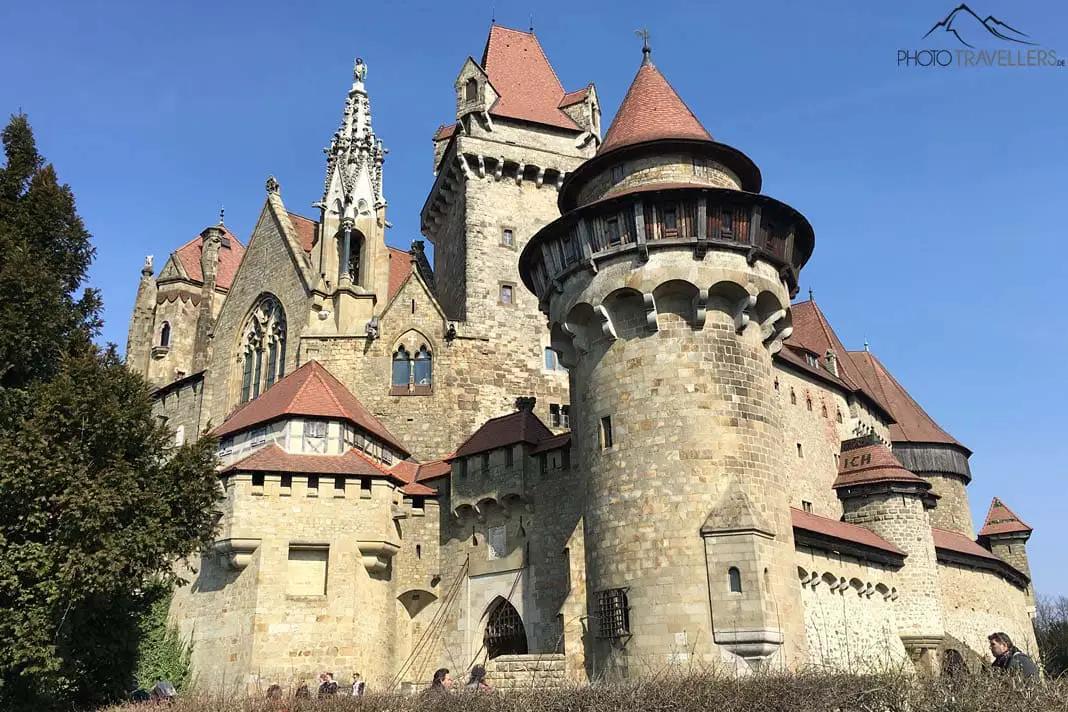
Kreuzenstein Castle is probably the prototype of the fairytale castle
Insider tip 4: Spittelau waste incineration plant
If you are travelling in Vienna, you will often see this huge tower with the golden sphere in the distance. The tower belongs to the Spittelau waste incineration plant, whose façade was artistically designed by Friedensreich Hundertwasser. A detour is definitely worthwhile. Also because the Spittelau waste incineration plant, built from 1969 to 1971 and rebuilt after a major fire in 1987, attracts far fewer tourists than other sights.
Useful info: Spittelau waste incineration plant

Vienna City Card and Vienna Pass
No matter what time of year: a city trip to Vienna is always worthwhile. There are countless sights to discover and once you've had enough of strolling around the city, sit down in one of the many cafés and enjoy a hot chocolate and a slice of Sacher Torte. The parks, museums and palaces are truly impressive.
Of course, this is especially true of Schönbrunn Palace, which really is a must-see. Or simply take a stroll through the area and let the city take its effect on you. There really is something to discover everywhere.
However, a trip to the Danube metropolis is not cheap. But with the Vienna City Card you can save a lot of money. With the card you can use buses and trains and get numerous discounts at museums, exhibitions, theatres or concerts, shopping, cafés, restaurants or the city's wine taverns. You can order the Vienna City Card here*.
There is also the Vienna Pass. It is more expensive, but includes free admission to numerous sights such as Schönbrunn Palace, the Giant Ferris Wheel, the Belvedere or the Hofburg. In addition, you can use the hop-on/hop-off buses for free. You can order the Vienna Pass here*.
Vienna tips on other travel blogs
You can find even more Vienna tips for an unforgettable city trip to the Danube metropolis on these travel blogs:
"Waltzing through Vienna. Very special travel tips for Vienna" on Looping Magazin
"Sightseeing Vienna - unusual tips for the up-and-coming 2nd district" on Good Morning World
"City break Vienna: historical sights, museums, squares, cafes, parks and cabaret" on Reise Zikaden
"Viennese Schnitzel, snails and a palace" on Travel Experience