Visiting Granada in Spain is one of the must-dos on a magnificent road trip through Andalusia. Along with Seville and Cordoba, Granada is the third city in the region not to be missed under any circumstances.
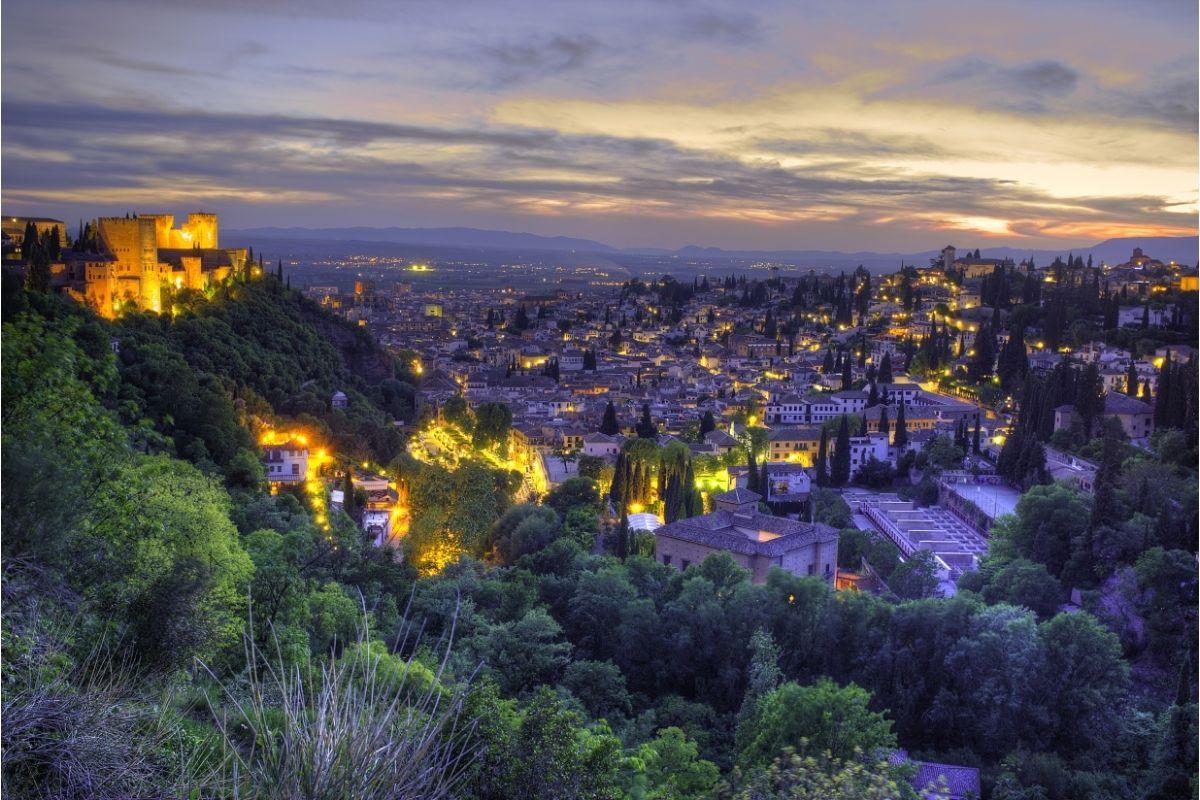
Granada is a lively, relatively large city with a unique and glorious past. In this article, you'll find all the must-see places, things to do, places to eat and places to stay in Granada.
Map of Granada
Granada is a city in the Andalusia region of southern Spain. It is the capital of the province of Granada, with a population of 231,775. It lies in the foothills of the Sierra Nevada mountains, the highest mountain range on the Iberian Peninsula. It lies 434 km south-east of Madrid, Spain's capital. It is one of the main towns in eastern Andalusia.
The city is a major agricultural and commercial centre located in the heart of a rich irrigated plain. Granada's main industrial sectors are sugar refining, brewing, distilling, chemicals and textiles. Tourism is a very important activity in Granada. It is an impeccable tourist destination.
In considering your next vacation trip, you may want to consider Granada. The city is one of the top 10 most-visited cities in Spain with its various tourist attractions and rich history. Granada's beauty is unparalleled and there are plenty of accommodations to choose from. For example, the Delfin Siesta Mar Hotel at http://delfin-siesta-mar.hotels-of-mallorca.com/en/ offers exceptional service and amenities to ensure your trip is unforgettable.
Furthermore, when planning a tour to Spain, it is important to research the best spots to visit. There are numerous resources online, one of which is tophotels.com . The website is extremely informative and provides an excellent overview of accommodations, attractions and much more.
Granada: a continental climate.

Granada has a tropical climate, with moderately cold winters and hot, sunny summers. The city is actually in southern Spain, around 700 metres above sea level, and a short distance from the Sierra Nevada mountains. As a result, it has a dry season from January to May and a rainy season from June to December.
Temperatures are high all year round, varying between 25 and 30°C.
So the best time to visit Granada is in winter, during the dry season, particularly from February to April. Unless you're going to enjoy the city's beaches, in which case the best time to visit is between June and the end of August.
Granada: a unique past

Granada was founded by the Moors in 756 near an ancient Roman colony, Illiberis. It was a Carthaginian possession under the Romans. Afterwards, it became dominated by the Byzantines and Visigoths.
After forming part of the Caliphate of Cordoba, it fell into the hands of the Almoravids in 1090, and then the Almohads towards the middle of the twelfth century.
The splendour of Granada began with the decline of Cordoba. Indeed, after the reconquest of Cordoba by the Christians in 1236, a large part of the Cordoban population took refuge in Granada, where Mohamed Ben Nasr founded the Nasrid dynasty.
The fate of Granada differed from that of the rest of Andalusia when the founder of the Nasrid dynasty decided to submit to Ferdinand III. It is said that Boabdil's mother reproached him: "You weep like a woman for what you were unable to defend like a man".
He then became the vassal of the Castilian king, which enabled his Muslim kingdom to survive and reach the height of its splendour!
The Catholic Monarchs took advantage of the dissensions within the dynasty and the decline of the kingdom to complete their Reconquest.
They excluded the Jews from the kingdom and created a Christian quarter with a cathedral, churches and convent.
Then they forced many Muslims to convert to Christianity, although they too were expelled a century later, and hunted down by the Inquisition...
Since then, Granada has lost its splendour and today remains a medium-sized provincial city, centred on its many universities and on tourism. Indeed, Granada is one of Spain's liveliest universities, with around 60,000 students studying at its prestigious university. This student life also ensures that Granada has a lively nightlife, trendy bars and no shortage of cheap tapas. Combine this with authentic neighbourhoods, colourful markets, flamenco and tapas culture, and you've got all the ingredients for an amazing city tour.
Granada's top 25 must-sees
1- Al Hambra

The Alhambra is the most visited monument in Granada, and indeed in the whole of Spain. It has been a UNESCO World Heritage Site since 1984. In fact, Al Hambra was one of 21 finalists to become one of the New 7 Wonders of the World.
It is a red palace built in the 13th century by the Moorish sovereigns to serve as their residence, covering more than 140,000 square metres. It comprises 3 essential parts: the Generalife summer palace with its beautiful gardens, the Palace of Charles V and the Alcazaba.
The Generalife was once the summer residence of the sultans. You can take a stroll through the sumptuous flower gardens, complete with ponds and fountains.
The Palace of Charles V is an enormous square Renaissance palace built under Charles V in 1527. It is located in the centre of the Alhambra. It was built after the Reconquest from the Moors. The large circular patio with its two colonnades is truly impressive. The architect of this palace was Pedro Machuca, a pupil of Michelangelo. The palace houses two museums on the Alhambra and Hispano-Moorish art.
The Alcazaba is a military fortress dating back to the 11th century. It is the oldest part of the Alhambra palace. It was the basis for all subsequent constructions. In fact, you can access several towers and enjoy the view over the city.
As many people want to visit the Alhambra, there is a daily quota of visitors. As a result, you should book your tickets for the Alhambra as soon as possible. Ideally, you should do so at least weeks or even months in advance in high season.
Allow a full day to visit this historic monument.
2- Dar El Horra Palace

The second palace you can visit in Granada is Dar Al Horra. This Moorish palace dates back to the 15th century.
It is located in the upper part of the Albaicín district of Granada. This palace was the home of Aicha. She was the mother of Boabdil, the last Moorish sultan of Granada. Dar-Al-Horra' is an Arabic word meaning 'House of the Honest'. The palace is discreetly hidden away in a very narrow alleyway. It is one of the last Nasrid buildings from the Moorish era.
After the expulsion of the Moors, the palace was used as a convent, known as the convent of Santa Isabel la Real. The palace is characterised by its beautiful interior courtyard with a swimming pool and religious inscriptions in sculpted plaster. After the Alhambra, the Dar-Al-Horra palace is a fine example of Moorish art, with its beautiful architecture and layout. Unfortunately, it is one of Granada's lesser-known sights, but it is nevertheless an interesting monument to discover.
3- The church of San Juan de Dios
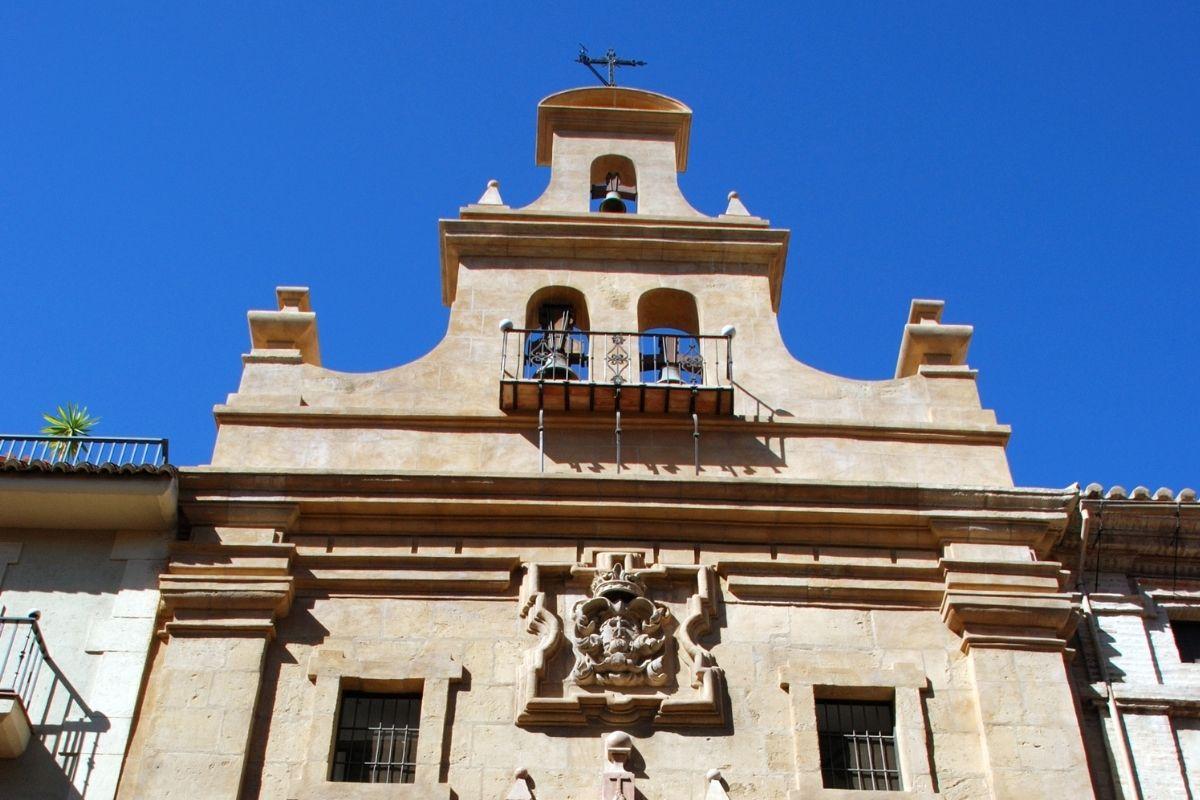
This Baroque "Church of John of God" was dedicated to the patron saint of Granada, John of God. Its exterior stands out for its dome covered in white and green tiles. It was built between 1737 and 1759. The facade of the church features two towers topped by spires and three niches containing illustrations of important moments in the life of John of God. Close to the church is also a small hospital founded by the patron saint "John of God", since caring for the sick was his main preoccupation.
From the outside, there's nothing original about the church. However, the interior is truly magnificent, with all its splendour and many riches. The colour gold dominates. There are also many impressive paintings, sculptures and wood carvings, large organs, a sumptuous altar and other objets d'art. This church is sure to impress.
4- The church of San Nicolás

The church of San Nicolas was built in the 16th century, on the orders of the Catholic royal couple, on the site of a former mosque dating from the Arab era. The church is located in the centre of the Albaicín quarter.
Near the church, in the Plaza de San Nicolas, you can enjoy a magnificent view of the whole of Granada, the Alhambra and the Sierra Nevada.
5- The monastery of San Jeronimo

If you're going to visit the church of San Juan de Dios, try to combine a visit to the church with one to the monastery of San Jeronimo, 100 metres from the church.
This is a Hieronymite monastery in the centre of Granada. It was dedicated to the patron saint, Jerome de Stridon. Construction of the Gothic monastery began in 1504 under the direction of the architect Diego de Siloé, following the arrival of the Catholic royal couple in the city.
The church of the Hieronymites monastery has a typically Augustinian building plan. It features the typical Latin cross with Gothic vaults and side chapels, a high priests' choir at the top of a wide staircase and an impressive altar.
The altarpiece is mainly by Pablo de Rojas and the icons depict the greatness of Gonzalo Fernández de Córdoba and Gran Capitán. He was a former duke who is buried with his wife in the church of the monastery of "San Jeronimo". This dedication to Gran Capitan was made in 1523 by order of King Charles V.
During the Spanish War of Independence, the inhabitants, the Hieronymites, were banished from the monastery and the town.
6- The Cartuja monastery
The monastery of La Cartuja is an impressive Carthusian monastery. It is located on the city's northern hill, around 3 km north of Granada city centre. It was built in the 16th century, in 1506 to be precise, but took 3 centuries to complete. It housed monks of the Carthusian order, one of the strictest and oldest religious orders in Christendom. They lived a hermit's life of prayer, silence and fasting.
The monastery is a blend of two architectural styles, Baroque and Renaissance. It is recognised as one of the most beautiful monasteries in Andalusia and the whole of Spain. The interior of its church is richly decorated despite the sobriety of the exterior. Indeed, according to connoisseurs, La Cartuja is the most beautifully decorated monastery in Spain.
7- The church of Santa Ana

The church of Santa Ana, whose official name in Spanish is "Iglesia de San Gil y Santa Ana", dates back to 1537. It is built in the Mudéjar style from brick. Its best-known feature is the beautiful portal and minaret, to which a bell tower was later added.
8- Granada Cathedral

Among Granada's tourist attractions, the cathedral and royal chapel are not to be missed.
The cathedral was built in the 16th century by the Catholic kings. It was dedicated to the Virgin of the Incarnation. It took almost 200 years to build. It is an architectural blend of Renaissance, Baroque and Gothic styles.
When you visit the interior of Granada Cathedral, you'll see a series of chapels and 2 organs dating back to the 18th century.
9- The Royal Chapel

Visiting Granada, and especially the city's cathedral, also means discovering the Royal Chapel or Capilla Real.
Attached to the cathedral, it can be visited separately. Its construction was ordered in the 15th century so that kings could be laid to rest there after their death.
It houses a crypt and a number of tombs of Catholic kings, including Isabel and Ferdinand, as well as a museum with a collection of works of art. An audio guide is available during your visit.
10- The Sacromonte caves
Sacromonte is a 15th-century gypsy quarter located on the Valparaiso hill next to the Albaicín district, with typical cave dwellings.
It is a truly marvellous testimony to Tzigan culture. The Sacromonte caves in Granada, with their steep streets, are home to an old flamenco tradition brought over by the Spanish gypsies known as "gitanos or Roma". We recommend an evening visit to one of the typical troglodyte dwellings for a flamenco show. The district also has a museum of troglodyte houses where you can admire the magnificent view from the Sacromonte Abbey while immersing yourself in the unusual atmosphere of flamenco and oriental dance.
If you decide to visit them, you'll also find eleven troglodyte houses carved into the rocks on the mountainside. At the same time, you'll have the chance to learn more about the history of the inhabitants of Sacromonte.
11- The viewpoints
A visit to the Miradors is a must if you want to admire the city of Granada and, above all, get a magnificent view of the Alhambra.
There are several, but the most famous is the San Nicolas viewpoint, located in the Albaicin district. It offers an impeccable view not only of the city's iconic monument but also of the Sierra Nevada in the distance.
In the same district, you can also visit the San Cristobal viewpoint. It stands next to the church of the same name.
Another viewpoint overlooking the city that is well worth a visit is that of San Miguel Alto. It also offers a fine view of the Alhambra, and is less crowded than the San Nicolas viewpoint. It is ideal for admiring a beautiful sunset panorama.
Overlooking the city, any visitor who ventures up here will feel like they've grown wings. Magnificent photos are absolutely guaranteed.
12- El Bañuelo
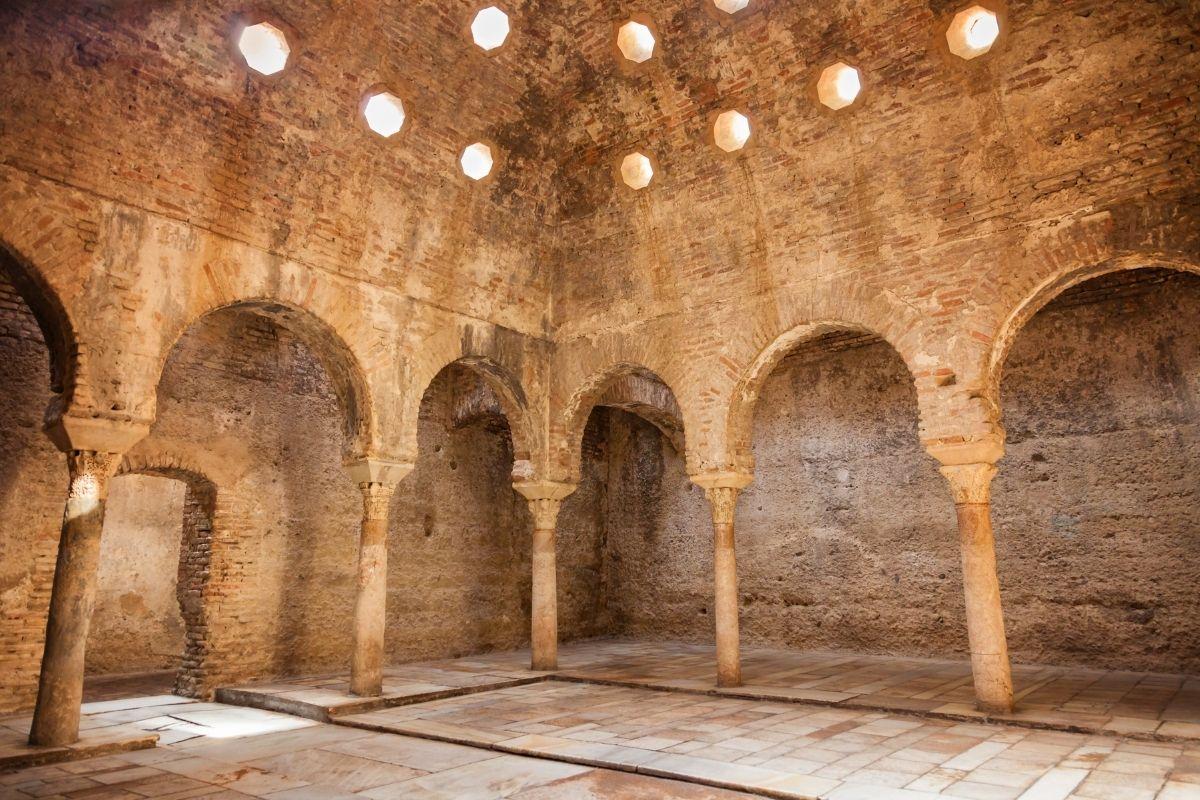
Granada's El Bañuelo, or 'Hammam' in Arabic, is the oldest and best-preserved public bath in Andalusia. The origins of these baths date back to the 11th century. This was during the period of Moorish domination. In those days, it was an important place not only for washing but also for socialising.
Most of the baths were destroyed during the reconquest by the Christians. For them, the Moorish baths had a reputation as brothels.
The old Arab baths consist of three rooms. The first, at the entrance, is the 'cold room', followed by the 'warm room', which is slightly larger and decorated with vaulted ceilings.
The most important room is the 'hot room', with its real baths decorated with vaults, columns and marble. Finally, the star-shaped skylights in the ceiling for the lighting and ventilation of the El Bañuelo baths are a must-see.
13- The Royal Chancellery
This is an imposing building that was built by order of Philip II in 1530. The Royal Chancellery is a fine example of Renaissance style. Several courts in Andalusia and southern Spain were governed from this chancery.
The Supreme Court also has its seat in this building. It also houses a prison dating back to the 17th century.
14- La Corrala del Carbón

"La Corrala del Carbón was once Granada's grain fair. It is also known as an Alhóndiga. It is located in the Albaicin district. It was built in 1336 during the period of Moorish rule under Yusuf I. It also served as a hostel where caravans of merchants could meet to sell and temporarily store their wares.
After the reconquest by the Catholics, La Corrala del Carbón was given the function of a coal market. Hence the name La Corrala del Carbón, which means the coal yard.
From 1593 onwards, the building was used as a theatre and community house. Today it houses a number of cultural institutions, a tourist information centre and craft shops. In fact, you can attend open-air shows that are sometimes performed in the courtyard. The monument consists of an entrance pavilion and a courtyard surrounded by galleries and craft workshops.
15- The Albaicín district

The Albaicín is the old Arab quarter of Granada. It is located on the hill opposite the Alhambra.
During the 13th century, it was a prosperous district with palaces and villas. The Moorish quarter of the Albaicín is a collection of narrow streets and squares lined with a multitude of whitewashed houses.
After the reconquest of Granada by the Catholic kings in 1492, the original mosques in this Moorish quarter were destroyed and replaced by churches.
Over the course of successive civilisations, the district has alternated between prosperous periods and periods of decay.
Today, only one Moorish palace remains in the district, Dar al-Horra, dating from the 15th century. You can also see other remains from the Moorish period, such as the aforementioned Arab baths, the church of San Nicolas in the Mirador de San Nicolas, the royal chancellery and other monuments. In conclusion, a stroll through the Moorish quarter of the Albaicín is a not-to-be-missed outing on your visit to the city of Granada.
16- Puertas de las Murallas
This set of gates dates from the 11th century. They were built over the Albayzín fort. Thanks to these gates, the whole of the Albayzín district was surrounded.
Today, four of the gates are still intact: Puerta de Monaita, Puerta de Elvira, Puerta Genil and also Puerta Nueva.
17- Plaza Nueva

The Plaza Nueva or Nueva Square is the oldest square in Granada. It was built to create a space and cover the Rio Darro river. It is a popular district, with a wide range of bars, restaurants and a large number of hotels, thanks to its central location.
18- Paseo de los Tristes

Paseo de los Tristes Granada, also known as Paseo del Padre Manjó, is Granada's best-known street. It was built in 1609.
The somewhat poetic name of the Paseo de los Tristes recalls the funeral processions that followed this route to the cemetery on the Sabika hill near the Alhambra.
Until the 19th century, the street was one of the busiest parts of Granada, thanks to the festivals and fiestas held here.
19- Plaza de Bib-Rambla

The Plaza de Bib-Rambla is located in the commercial area of the centre of Granada. It is a very lively place. It features several terraces, florists, street artists, lime trees and public benches. The square is surrounded by a number of houses dating back to the 19th century.
In the past, bullfights and torture at the stake during the Inquisition took place in this square. In the centre of the square there is a 17th-century fountain with a statue of Neptune and lampposts from the same century.
The Plaza de Bib-Rambla is the ideal place in the city to enjoy a churro au chocolat, for example, on one of the terraces. Around the square you'll find all kinds of shopping streets, such as the Alcaicería and the Arab market, which used to be the silk market. Today it is a jumble of streets and stalls selling mainly souvenirs.
20- La Alcaicería

The Alcaicería market is Granada's Grand Bazaar. The name Alcaicería has Roman origins, as the Arabic al-Kaysar-ia means "Caesar's Square". The monument was built to thank the Byzantine emperor Justinian for giving the Arabs the exclusive right to manufacture and sell silk in the sixth century. The original Alcaicería was built in the 15th century. It was the city's Moorish silk fair, full of stalls of Arab silk, spices and other valuable goods. Unfortunately, it was destroyed by fire in the 19th century. In fact, the current replica is less than half the size of the original. It was also a modern, less flamboyant version of the Moorish and neo-Moorish style. Today, the only remaining part of the bazaar is Calle Alcaicería. This is a sort of neighbourhood with a rich history and important local culture where you can buy interesting and exotic things such as traditionally painted ceramics, inlaid wood and stained glass lamps. Granada's bazaar is ideal for tourists and the narrow streets are mainly made up of small souvenir and fabric shops.
21- The Centro Sagrario
The 'Sagrario' centre is Granada's lively city centre. It was founded by the Christians. Here you'll find shopping streets, squares full of tapas terraces and, of course, the cathedral and other religious buildings. There are also a number of monuments of Muslim origin, such as the old caravanserai and the medersa.
22- Granada Science Park

If you're visiting Granada with children, we recommend you visit the Science Park or Parque de las Ciencias. It's about a 15-minute walk from the city centre.
According to statistics, it is the most visited museum in Andalusia. It covers an area of 70,000 square metres. The museum offers you the chance to find out all about planet Earth on a journey to the heart of the universe, with 110 projectors reproducing more than 7,000 stars. You can also learn about the human body in a fun and interactive way, and explore the themes of sound and light in a room called "perception". There's also a planetarium.
The museum also includes a botanical garden, a butterfly greenhouse and a 50-metre-high observation tower with a panoramic terrace.
23- Carmen de los Mártires Park

"Carmen de los Mártires is a beautiful park in the south of Granada, close to the Alhambra Palace. It will provide you with the peace and quiet you are looking for, as few tourists visit this area. It's a romantic park that reflects a mix of English and French styles. You'll also have a magnificent panorama of Granada from the park.
If you do decide to visit, take a walk in the shade near the ponds and ducks, watch the peacocks, watch the locals take their wedding photos or relax with a picnic in this little-known 7-hectare park.
What's more, in the pond is an old aqueduct that you can reach via a bridge.
24- The Sierra Nevada trails

You may not know it, but it is possible to ski in Andalusia. The 3478-metre-high Sierra Nevada is just a 50-minute drive from Granada. They offer some great descents.
In winter, this mountain range is perfect for skiing. The most famous spots are around Monachil, Pradollano and Borreguiles. Snow generally falls between December and April.
For the rest of the year, the Sierra Nevada is an ideal place for hiking. There are plenty of hiking trails. You can also enjoy a wide range of other activities, such as mountain biking, paragliding and rock climbing.
You can hire all the equipment you need.
25- Attend a Flamenco show
Flamenco is a typical Spanish dance and music. It is an ancient tradition among the gypsies who live in the Sacromonte caves. Their gypsy ancestors succeeded in creating a blend of traditional Spanish flamenco and oriental belly dancing. A range of flamenco shows are performed today in the cave dwellings of the Sacromonte: these bars are also known as tablaos. You can also enjoy a Flamenco show in the Albaycín, the old Arab quarter.
Beaches in Granada
The coastline of the province of Granada is widely known as the Costa Tropical. It is renowned for its favourable weather conditions, its sunshine almost all year round and its extraordinary beaches.
Here's a list of the most beautiful beaches in Granada.
1- Peñón de Salobreña beach

One of the best-known beaches in the region is undoubtedly Peñón de Salobrena. It has 1.85 km of thick sand. The beach offers a wide range of services, including lifeguard surveillance and access for people with reduced mobility.
2- Calahonda beach

This urban beach is 1.2 km long. It is characterised by thick black sand and clear, calm blue water. It was recently awarded the Blue Flag by the Foundation for Environmental Education. It offers a range of services to its visitors, including toilets, showers, gangways, a cleaning service and a lifeguard service. There is also a Red Cross centre and access for people with reduced mobility. There is also a 100-space car park. It's worth noting that this beach is very popular, especially during the summer months.
3- Cantarriján beach
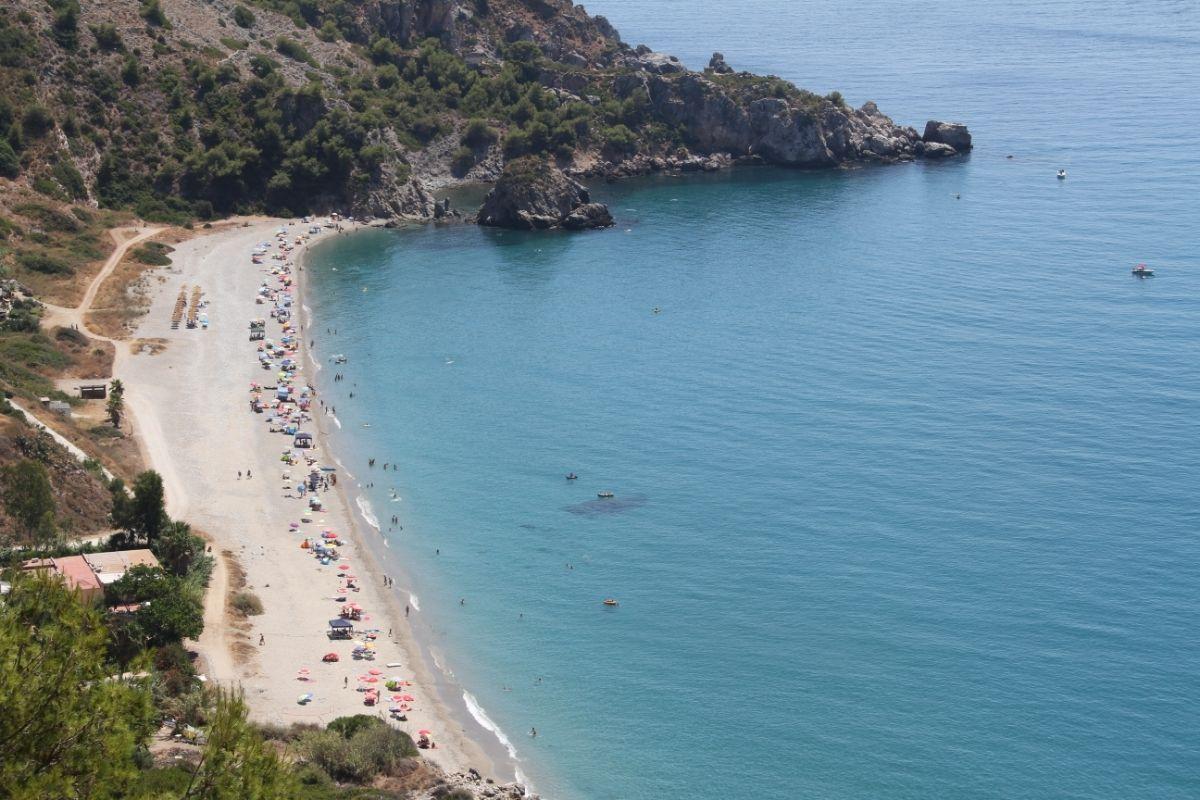
This small beach, just 380 metres long, is located in the Maro-Cerro Gordo Natural Park, around 79 kilometres from Granada. Its sand is both fine and thick. This makes it ideal for scuba diving.
However, access to this spot is a little tricky, despite its very high visitor numbers. You can get there by car, bus or boat.
Cantarriján beach offers a range of facilities, including showers, toilets, cleaning services, walkways and hammock hire. There are also bars and restaurants.
4- La Herradura beach

This beach is 2 kilometres long. It lies at the foot of the Sierra de la Almijara, 7 kilometres from the town of Almuñecar. It is surrounded by lush vegetation. The beach is characterised by its black sand mixed with gravel.
The beach has a medium level of use, although it can be very busy due to its urban location. Services include lifeguard and rescue services, local police, hammock and parasol hire, showers, toilets, cleaning, walkways, chiringuitos and a children's area.
The view from the promenade is simply fascinating. The promenade is also suitable for people with reduced mobility. There is also a car park. As far as transport is concerned, the nearest bus stop is located right next to the Puerto Deportivo Marina del Este. There's also a sports facility where you can try your hand at scuba diving.
5- La Joya beach
This beach stretches for 600 metres along the small bay of La Joya. It is surrounded by a cliff and rocks that protect it. Access is difficult, as you have to climb down 200 steps. Please note that there are no services at all.
6- La Rijana beach

This beach is 250 metres long. It is 20 kilometres from Motril. It is an ideal spot for scuba diving, as the waters are incredibly pure and calm.
The only thing you'll find here is a chiringuito where you can enjoy delicious fried fish or a cocktail while admiring the beautiful view over the immaculate bay.
7- La Guardia beach

The 1.1 km of black sand on this beach make it a very charming spot. It is characterised by the presence of picturesque little huts, built by the locals who want to spend relaxing days on the beach.
What's more, you'll have the chance to have a barbecue or cook up some delicious espetos. This beach has all the facilities you need: lifeguard service, first-aid post, car park and kayak hire.
8- San Cristóbal beach

This black sand beach is also known as La China. It stretches for 1.1 kilometres in the urban area of Almuñecar. Its shores are surrounded by lush vegetation and crystal-clear water.
It is very popular with visitors. It offers visitors a range of services, including lifeguard surveillance, a first-aid post, local police, toilets, showers, hammock and parasol hire, a cleaning service, litter bins, children's areas and a chiringuitos where you can enjoy delicious fried fish.
9- El Ruso beach
This beach was formerly known as Lance Nuevo. It is 200 metres long. Its new name "de EL RUSO" is the name of a soldier in the Soviet army who fled the Soviet regime in 1921 to reach this bay. There are very few visitors to the bay, given the total lack of facilities and the difficulty of access.
You can get there by boat or on foot along a steep path.
However, this beach has deep black sand. The waters are clear and fairly calm.
10- El Cambrón beach
The name of this small beach is a reference to the urban area of Torre del Cambrón. It is just 86 metres long. It is more than 60 kilometres from Granada. Unfortunately, you won't find any facilities on this fine gravel beach.
The nearest car park and bus stop are 2 kilometres from the beach. For this reason, we advise you to keep in mind the telephone number of the nearest Red Cross station, which is +34 958 82 59 60.
Accommodation in Granada The best areas to stay in Granada
Granada is divided into four old towns and around ten neighbourhoods. Each district has its own culture, identity, history and, consequently, its own atmosphere.
Some are popular, festive and ideal for enjoying a surprise flamenco concert. Other districts, on the other hand, are a little quieter. Here's an overview of Granada's four main districts.
"The Albaicin

This district is a complete change of scenery, with its white buildings, maze of narrow stone-paved streets and typical Muslim architecture. This is Granada's medieval quarter.
Albaicin offers uninterrupted views over the city, flower-filled windows and a peaceful atmosphere. If you're looking for accommodation, we recommend renting a flat with a view of the Alhambra, so you can wake up to a heavenly morning and enjoy the sunset from the viewpoint of Saint-Nicolas.
"The Realejo

The Realejo is a friendly, festive and very active district. It has a wide range of bars and restaurants with terraces. The typically Andalusian Carmen de los Mártires Gardens are the district's main tourist attraction. It is also home to the famous Alhambra and a large part of the Dehesa del Generalife park.
This is the ideal place to stay in Granada if you love parties and nightlife. Note that there are a lot of tourists here.
"The Sacromonte

This district is the legacy of the old gypsy town. Many flamenco shows take place here. But this is more a tourist attraction than a cultural tradition. If you choose to stay in this part of Granada, it will be like being immersed in another time.
List of some hotels in Granada
Granada has a large number of hotels. Most of these hotels are located in the centre.
1- Parador de Granada

This is one of Spain's "state hotels", located in unique locations and often in historic buildings. This is a luxury hotel. You won't find a better location in Granada.
2- Hostal Rodri
This hotel offers an exceptional location with a very pleasant interior design: stone walls, graphic arches and patterned ceilings.
3- Anacapri
This hotel occupies a typical 18th-century house in the old town. It has retained many of its original features despite a careful renovation that reflects the architectural customs specific to the region.
4- Sacromonte
Right in the heart of Granada. It is richly decorated. In fact, as soon as you cross the threshold of its chandeliered lobby, you'll feel as if you've just stepped inside. Elegant woodwork and sumptuous tiled floors confirm the classy feel of this accommodation. Deep sleep is guaranteed in the rooms of this hotel.
5- Shine Alcaiceria
Located in the bustling souk of Granada. This hotel offers air-conditioned accommodation with views over the city. Its decor reflects both voluptuousness and authenticity. It is very close to the Alhambra and the Paseo de los Tristes.
6- Granaxperience Apartamentos
If you book at this hotel, you'll have access to a jacuzzi. What's more, you'll be able to enjoy some great evenings out on the rooftop terrace.
7- Gar Anat Hotel

This is a very charming hotel housed in a restored 17th-century building. It is ideally located in the centre of the city.
8- Posada del Toro
This is an establishment that honours Andalusian traditions. It has a courtyard dating back to the 19th century. It exudes an exceptional charm. It is just a few minutes from the Town Hall and the Cathedral. This is one of the best hotels in Granada if you're looking for a central location.
9- La Posada de Quijada
This is located near Calle Caldereria. It is known for its lively atmosphere. It's an ideal option if you want to enjoy the city's sparkling atmosphere.
There are plenty of tapas bars in the vicinity of this hotel. What's more, the rooms at this hotel are pleasant, comfortable and cosy.
10- Hotel Casa Morisca
Located in the historic Albayzín district, with views of the Alhambra. It is a beautifully renovated manor house with rooms set around a comfortable patio, offering very reasonable value for money.
11- Oripando Hostel
Located 300 metres from the lively Albaicin district. The major advantage of this hostel is that it is very close to all the must-see places in Granada. It features a communal lounge, garden and sun terrace. It is a very pleasant option for relaxing between visits.
It also offers a wide range of entertainment, from films to table tennis.
12- Hostal Veronica
This hotel is located in a lively area of Granada. It offers affordable rooms and a pleasant rooftop terrace. Despite its central location, the hotel is fairly quiet.
13- Eurostars Catedral
This is one of Granada's top hotels. It is located right next to Granada Cathedral. It offers bright, soundproofed and spacious rooms and a tasty restaurant.
14- Bibo Plaza Nueva

This hotel is renowned for its warm, sophisticated decor: stone walls, light effects and cosy curtains.
Restaurants in Granada
Granada has a wealth of restaurants. In fact, you can easily find a cheap restaurant in Granada. As in the rest of Spain, tapas are very popular in Granada. The advantage of the university city of Granada is the tradition of free tapas offered to accompany every drink. As a result, it's always a battle between the different bars to see which one offers the best tapas and which one gets you as a customer. After a few drinks, you're no longer thirsty, but your hunger is gone too.
There are many bars and restaurants in the streets around Plaza Nueva, especially on Calle Elvira and Calle Calderería, Gran Via, Plaza del Carmen and the adjacent Calle Navas. You'll find some great terraces around the Campo del Princip square. And on the terraces of the Paseo de los Tristes, you can easily enjoy a drink with a magnificent view of the Alhambra. Below is a list of the bars and restaurants you can visit.
-
Bar Los Diamantes

This bar has 80 years of history. It is renowned for the high quality of the seafood it serves. The dishes, delicately prepared to retain the best flavours and quality of Mediterranean cuisine, are extremely delicious. A single dish costs between €12 and €18.
One of the many advantages of this restaurant chain is the number of establishments it has in the city of Granada. You can find up to five bars in the following locations: Calle Navas, Calle Rosario, Plaza Nueva and Calle Torre de Peralada. They are known as the best place to eat tapas in Granada. It's a very popular spot, so try to get there early to get a table.
-
Restaurant El Trillo
Located in the Albaicin district. The restaurant serves delicious, generous Spanish dishes, always with a touch of the traditional recipe. The terrace offers a beautiful view of the Alhambra. Please note that you must reserve a table in advance.
3- El Quinteto
This restaurant is close to the Bib-Rambla square. It offers delicious traditional dishes with a modern twist. They use high-quality ingredients and the staff are very friendly.
4- El Mesón el Cordobes de Jose Peregrina
This restaurant is located a little way from the city centre, on Calle Artesano Molero. It's the ideal place to eat one of the city's best paellas, accompanied by a glass of sangria.
5- Entrebrasas

"Entrebrasas is on Calle Navas, just 5 minutes from Granada Cathedral.
This restaurant offers a variety of grilled meats. It specialises in grilled meats. As for the price, a meal per person costs around 15 euros, a very affordable price for such high quality. The interior of this restaurant features a rich wood decor, making it more than welcoming.
Without a doubt, this is the best option for carnivores too, although it should be added that they don't just specialise in meat. The restaurant also offers vegetarian and vegan options in a variety of high-quality dishes, as well as in their tapas.
6- Bar la Riviera
This bar is located at number 7 rue Cetti Meriem, just a few minutes from the cathedral. This is one of those bars where you can enjoy top-quality tapas with a full wallet.
It is characterised by its typical design and affordable prices per glass, which cost around €2.
Bar la Riviera is a must for those who like to enjoy a beer in a quiet atmosphere and in good company.
For beer lovers, they also offer a wide variety of national and international options.
7- Cacho&pepe
Cacho&Pepe is located at number 6 Calle Colcha, very close to Plaza Nueva and Plaza de Isabel la Católica.
In this restaurant you can enjoy the most popular Italian cuisine without leaving Granada. In fact, you can choose from a variety of starters, lasagne, pasta and pizzas, all homemade and at a price that is unimaginable for its quality. It's between €4 and €6.
Although you can just order takeaway, it never hurts to visit the place and see its comfortable, familiar design and atmosphere.
8- Tocateja
This restaurant is a good option for enjoying Spanish cuisine with flamenco accents, plentiful portions, a renowned wine bar, good starters and main courses.
It is located at number 8 Calle Trinidad, very close to the botanical gardens of the University of Granada.
A dish costs between €10 and €15 per person.
9- Mesón el Yunque
If you're in Granada and want to visit the Albaicín district, or if you're already there, you'll find Mesón el Yunque right next to the Mirador de San Nicolás, in the Plaza San Miguel Bajo.
This bar offers excellent value for money on its menu. The price is between 10 and 15 euros per person, including a drink and a free tapa.
The restaurant has a lovely terrace where you can enjoy your meal.
This place has many advantages. A small street is all that separates you from the incredible views of the Alhambra. Being located in the Albaicín district, you can feel the freshness and good vibes of urban Granada.
Gastronomy in Granada
Granada is a highly multicultural city, with a glorious history and a cuisine that is strongly influenced by spicy and oriental flavours. What's more, Granada's cuisine is rich in vitamins and nutrients, as it is based on fresh produce grown in Andalusia. This is a land that is cultivated and pampered by the sun most months of the year. Below is a list of traditional dishes from Granada that you're sure to want to try.
1- Sacromonte omelette
The Sacromonte omelette, or "sacred mountain", is the typical Granada omelette, named after the Sacromonte district of Granada. It is a very elaborate omelette, containing much more than an ordinary potato omelette. It is made with sheep's brains, criadillas, Serrano ham or chorizo and other types of offal, and usually peas, walnuts and breadcrumbs are also added.
The Sacromonte omelette is traditionally a gift from the gypsy community to all those who climb the Sacromonte hill on Saint Caecilio's day to honour their patron saint.
The Sacromonte district of Granada is the ideal place to try this dish.
2- Remojón granadino

Remojón granadino or remojón de naranja is Granada's most typical summer dish. It comes from the Arabic tradition that was present for years in Muslim Granada. It is also typical of the Spanish provinces of Almería, Málaga and Jaén. However, the recipe varies depending on the locality. It is a kind of refreshing salad whose basic ingredients are orange and olive oil. If you eat it with salt, it's a salad. If you add sugar, it's a dessert. It is typical to add cod to the salted version as well as olives, eggs, onion, garlic, vinegar, paprika and also potatoes or tomato.
3- Moraga de sardines
Moraga de sardinas is Granada's most typical seafood dish. It is mainly cooked with Motril sardines. The sardines are placed in an earthenware dish and bathed in white wine, lemon juice, olive oil, garlic, parsley and salt. Once all the ingredients are in the pan, they are put on the heat for 10 minutes until ready to eat.
4- Zalamandroña salad

Zalamandroña is a typical food of the municipality of Guadix, whose origins date back to the Andalusian period in the 9th century. The recipe is based on vegetables dried in the sun during the summer: roasted and dried pepper, courgette, pumpkin and dried tomato. To these vegetables are added desalted and crumbled cod, black olives and olive oil.
5- Broad beans with ham
Beans with ham are a typical Granada dish. Although it is cooked all over Spain.
At the time of the Spanish Inquisition, it was crucial to show your acceptance of Christianity. And the easiest way to do this was to eat pork. Since eating pork is forbidden in Islam and Judaism, the ingredient began to appear in Spanish dishes, including beans with cured ham. In addition, the Muslims introduced beans in the 8th century. Beans with ham are the perfect example to demonstrate the undeniable link between the cultures that Granada has experienced.
6- The San Antón stew
Olla de San Antón, or Sanantonada, is a typical stew from Granada, Murcia and Jaén. It is a well-known tradition in the Spanish city.
In fact, the traditional slaughter of the pigs took place at the beginning of each year, around the time of Saint Anthony's Day. The origins of this dish date back to the Spanish Civil War, when the locals decided not to waste a single piece of pork that had been left over after sausage-making. So they improvised a stew with beans, rice and all the leftovers from the slaughter, including the tail, the spine and more.
The pig is slaughtered on the feast of San Antón, on 17 January each year, which is why the dish is given its name. As a result, during the first weeks of February, Granada's traditional restaurants will serve "Olla de San Antón" until they run out of ingredients.
7- Aubergines with cane honey
Aubergine with cane honey is a dish that dates back to Arabic times. It is popular throughout Andalusia, but is typical of Granada and Cordoba. You can try it in bars and restaurants. The dish is served as a tapa or a full portion.
8- Gurupina

Gurupina is a traditional dish from the municipality of Baza. It consists mainly of kid meat, garlic, pepper, fried bread, white wine and almonds. Gurupina is served with courgettes or fried potatoes.
9- Tapas in Granada
Like all Spanish cities, Granada is famous for its tapas bars, where you'll receive a generous tapa every time you order a drink.
In some bars, you can choose the tapa you want from the menu.
10- The Alpujarreño dish
The Alpujarreño dish, as its name suggests, is a traditional dish from Alpujarra, a mountain village in Las Alpujarras. It is a dish much loved by the people who live in this region. This dish usually contains potatoes, black pudding, lomo de orza, longaniza sausage, papas a lo pobre, fried eggs and Alpujarra cured ham. It's quite simple and easy, but delicious. The combination is just unbeatable.
11- Piononos de Santa Fe
Piononos de Santa Fe are the most typical of Grenadian sweets. As their name suggests, they come from the town of Santa Fe, in the La Vega region. This delicious dessert consists of a sheet of sponge cake soaked in syrup, filled with custard and rolled up, sprinkled with caramel and sugar.
12- Soplillos de l'Alpujarra
The recipe for Soplillos de la Alpujarra is very old. It dates back several centuries, as it is a typical Andalusian dessert. Over the years, the recipe was passed on to the monasteries, where the nuns made them at Easter and Christmas. Soplillos de la Alpujarra are made with eggs, sugar, almonds and lemon.
13- Carnival curd
This dessert, like the Pot de San Antón, was born when people wanted to make the most of their leftovers. In this case, the leftovers were Mantecados, typical Christmas sweets. Mantecados contain almonds, sugar, olive oil and cinnamon. This typical Granada dessert is served in typical Fajalauza de Granada ceramic bowls.
14- Piononos
This dish originated in the historic town of Santa Fé. The locals made it to honour Pope Pius IX. It is a sort of juicy sponge pie with grilled cream on top.
15- Montefrío cheese
The town of Montefrío is "one of the towns with the best panoramic views in the world", according to National Geographic. Montefrieno cheese is a traditional and very popular dish in this town. It is certainly a must on the list of typical Granada dishes that you must try on your visit to Granada.
16- Jamón de trevelez
This ham is salted. It is called "trevelez ham" because it is salted in Trevélez, one of the towns in the Alpujarras mentioned above.
Jamón de Trevelez was chosen as the Spanish royal family's private brand of ham. The town is more than 1,400 metres above sea level. The air that helps the meat curing process and the unique and ideal climatic conditions are the ingredients that make ham be unrivalled. If you spend a few days in the city, you'll realise that it features in most of Granada's typical dishes.
17- Alfacar bread

This is a traditional bread, considered to be one of the best in Spain. It reflects Granada's Muslim heritage. The Moorish ovens where the bread is baked give it a unique smoky flavour that locals love. A slice of bread toasted with alfacars and a little olive oil is the best breakfast in Granada.
Festivals in Granada
1- Toma de Granada
Every year on 2 January, the reconquest of Granada by the Catholic kings is celebrated. If you're passing through, you can watch a parade in 15th-century costumes with the city's banner.
2- Epiphany
Epiphany is an important public holiday in Spain, and also in Granada. It symbolises the arrival of the three Magi, Balthasar, Caspar and Melchior. On 5 January, at the end of the day, a huge parade of floats is held, during which sweets and treats are distributed throughout the city of Granada.
The 'Día de los Reyes Magos' is also celebrated at home on 6 January. Children receive presents.
3- San Cecilio:
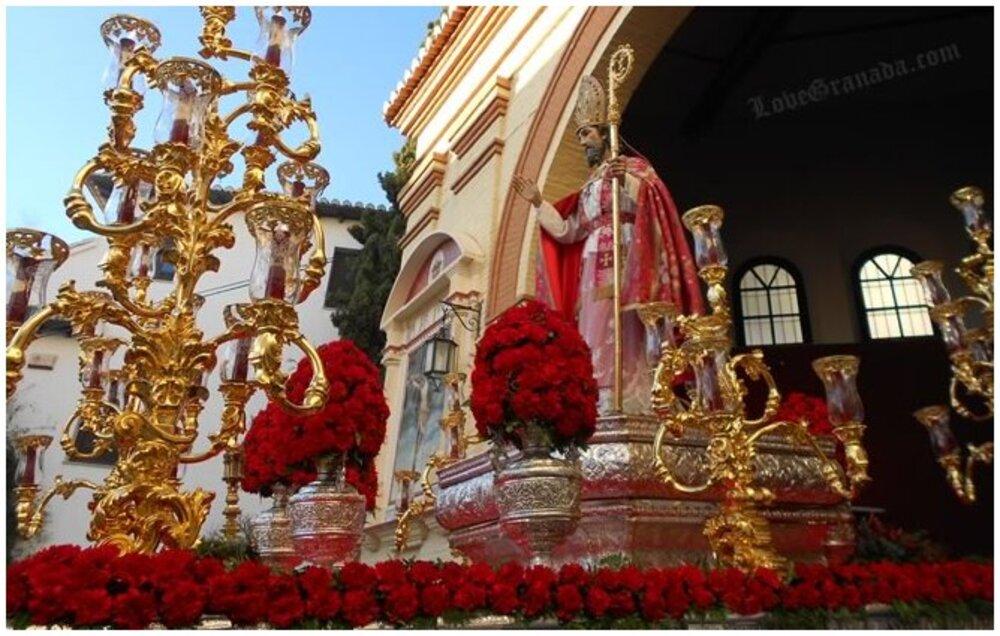
This is a local feast day that takes place on 5 February every year in Granada. The patron saint of Granada is celebrated. Tradition involves visiting the catacomb of San Cecilio at the Sacromonte Abbey.
4- Festival Internacional de Jovenes Realizadores
This is the festival for young filmmakers held in Granada in April.
5- Semana Santa
As in every other city in Spain, 'La Semana Santa' is also celebrated in Granada. During this week, there are impressive processions with the astonishing pointed capirotes and a pictorial return to the Way of the Cross of Jesus. This is an event not to be missed if you're in Granada. However, make sure you're there well in advance so you can reserve a place along the route.
6- Labour Day
May1st is Labour Day in Spain. It is a public holiday. So be aware that many shops and tourist sites are closed.
7- Cruces de Mayo
May 3rd is the day on which the "Cruces de Mayo" are celebrated. Beautifully decorated crosses are placed all over the city of Granada. The festival is characterised by dancing, flamenco dress and music.
8- Mariana Pineda's birthday
Mariana Pineda's birthday is celebrated every year on 26 May. She was sentenced to death for her liberal beliefs. Activities in commemoration of Mariana Pineda are carried out in a square of the same name.
9- Corpus Christi
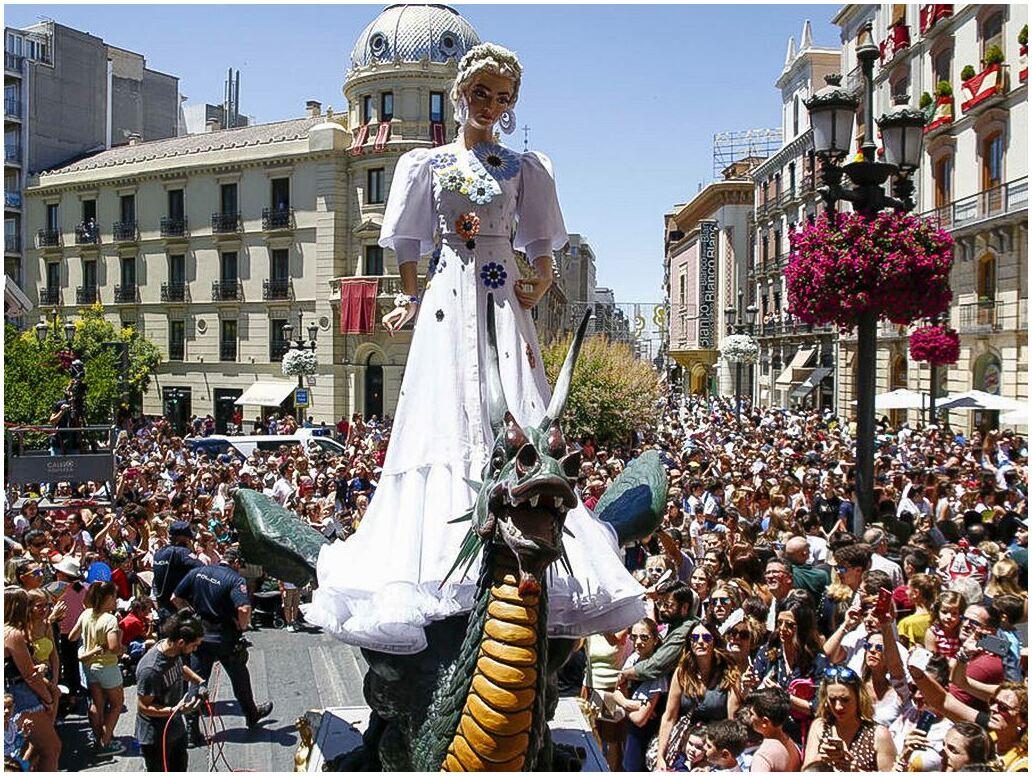
Corpus Christi is celebrated on the second Thursday after Pentecost on 15 June. The festivities last almost a week. A mass is celebrated in the cathedral and two processions are organised. During this week, there is also a fair with marquees and stalls. The site is located in the Almanjáyar district, a little way out in the north of the city.
10- International Music and Dance Festival
This festival takes place in the Alhambra, the Generalife gardens, various monasteries and the cathedral during the months of June and July. The programme includes opera, classical music, ballet and flamenco.
11- Fiesta de la Virgen de las Angustias
This is the feast day of the town's patron saint, which takes place on 15 June. The façade of the church of the same name is covered in magnificent flowers. There are also processions and various festivities.
12- Fiesta Nacional de España
October 12th is Spain's national holiday. All shops are closed.
13- Hocus Pocus festival
This takes place in November. Magicians and illusionists perform all over Granada.
14- Día de la Constitución
6 December is Constitution Day in Spain. It's a national holiday that's best celebrated with the family.
15- La inmaculada
This is celebrated on 8 December. It is the immaculate conception of the Blessed Virgin Mary. It is a bank holiday. However, it is not a special day in Granada. Many Spaniards take advantage of these public holidays and go away for a long weekend.
16- Christmas
On 25 and 26 December, you can enjoy the Christmas market in the Plaza Bib-Rambla.
17- La Noche Vieja
Granada is a pleasant destination where you can celebrate New Year's Eve with fireworks in the Plaza del Carmen. Tradition has it that everyone must eat 12 grapes at midnight, one at each stroke of the clock, accompanied of course by a glass of cava. Afterwards, the festivities move to the nightclubs. Tickets must be purchased in advance.
Itinerary in Granada
Most of Granada's tourist attractions can be reached on foot from the centre. However, you can use the excellent Rober bus network. These minibuses also run through the steep, narrow streets of the Albaícin district.
Granada's bus station is three kilometres from the city centre on the Carretera de Jaén.
This is where you'll find all the regional buses leaving for the cities of southern Spain. A single ticket in the city costs €1.20. You can buy your tickets from the driver. If you want to visit the major sites for a few days, we recommend that you buy an AlhambraCard ticket.
The AlhambraCard is a good option if you are going to visit several places in Granada and want to use public transport. It includes a ticket for the famous Alhambra and Generalife, the Cathedral with the Royal Chapel, the Cartuja Monastery, the San Jerónimo Monastery and also the Science Museum.
The AlhambraCard is valid for 3 days. It is therefore very useful for a longer stay. It will allow you to avoid the queues at the Alhambra. The price is €49 for adults, and children aged between 3 and 11 pay just €15.50.
As for taxis in Granada, they are much cheaper than in France. Prices vary according to the taximeter and are always clearly displayed inside the taxi.
As many of the sites are within walking distance of each other, you probably won't need to use taxis very often.
You can simply stop a taxi in the street. Taxis with green lights are available. Please note that a higher night fare applies at night. For example, a journey from the centre to the Alhambra Palace will cost you around €7.
Granada has a train station with good connections to the following cities: Seville, Madrid and Cordoba. Only Malaga is not easily accessible by train.
Granada Airport

Granada has an airport, but unfortunately there are no international flights. So if you want to visit Granada, you'll have to take a flight to Malaga. There are several ways to get to Granada from Malaga airport:
-
Car hire: Granada is 125 kilometres from Malaga, so it's an hour and a half's drive from the airport.
-
The "ALSA" bus: this takes you directly from Malaga airport to Granada in approximately 2 hours. Granada bus station is about 4 kilometres from the centre. A single ticket costs around €13. It's worth mentioning that it's sometimes cheaper to go to Malaga bus station first and then take the bus to Granada.
-
Train: Unfortunately, there are no direct high-speed trains between Malaga and Granada. As a result, this option is often impractical. The journey takes around 2 and a half hours. What's more, you have to change trains several times. A single ticket costs around €20.
Favourite places in Granada
1- Al Hambra
Granada is synonymous with the Al Hambra. It's a fascinating monument to visit when you're in Andalusia. It really is a fantastic monument.
2- A flamenco show
Seeing a flamenco show in Granada is a must, especially in the region where the practice originated.
3- A hammem session
A hammem session in Granada is a moment of relaxation in a magnificent and atypical setting. It is also an opportunity to immerse yourself in the city's Moorish past.
4- Explore the 'ALBAICIN' and 'SACROMONTE' districts
Exploring the Albaicin and Sacromonte is one of the must-do areas in Granada. In fact, you can't visit Granada without visiting these two districts. They are the city's two oldest neighbourhoods and have a slightly different atmosphere to the rest of Granada.
5- Tapas
Granada is the cradle of the free tapas culture. Every corner of the city has a collection of bars and restaurants where you can enjoy delicious tapas with a refreshing drink.
FAQ
-
Why is Granada called Granada?
The origin of Granada's name has been the subject of much debate. The Arabs are said to have named it Gart Al-Yahud. This means the pomegranate of the Jews, so the name could also come from Arabic (ḡarnāṭa) or even Latin (granatum) the fruit, pomegranate.
-
How do I get to Granada from Malaga?
The best way to get from Málaga to Granada is by train. The journey takes 1 hour and 12 minutes and costs between €13 and €17. Alternatively, you can take the bus. This costs between €9 and €17 and takes 2 hours.
-
Which airport is best for visiting Andalusia?
The two most important international airports for flights to Andalusia are Seville and Malaga-Costa del Sol. Scheduled direct flights from Paris to Malaga are easy to find.
-
What to do in Granada with children
You can visit Aquaola water park and the science museum.
-
When is the best time to visit the Alhambra in Granada?
April and May are a good time to visit the gardens of this monument, as the weather is fine.